Menopause Journal for Women:
7 Pages That Actually Help
By Journalyn · · 7 min read
TL;DR
- A menopause journal serves two purposes: turning symptoms into actionable data, and supporting the identity shift this transition requires.
- The 7 most useful page types: daily body check-in, one thing my body is doing right, hormone wisdom, releasing and claiming, joy found today, HRT log, weekly empowerment review.
- Most menopause resources address only the physical. The identity dimension is what separates women who find this transition empowering from those who find it only difficult.
- A menopause journal is most useful from mid-perimenopause onward. For earlier tracking, a perimenopause symptom tracker addresses the variable transition phase.
A menopause journal has two jobs: make your symptoms legible, and help you build the woman you are becoming.
Why menopause deserves a dedicated journal
Most women approach menopause with inadequate preparation. The physical transition is known, however incompletely. The identity transition is almost entirely unacknowledged. The research on psychological wellbeing through menopause consistently identifies two factors that predict positive outcomes: a reframing of menopause as transition rather than decline, and an active construction of what the post-menopausal chapter will hold. Neither of these happens automatically. Both of them happen in writing.
The women who report menopause as the beginning of the best chapter of their lives are not simply lucky. They are women who did the meaning-making work. A journal is how that work gets done.
The 7 pages of a useful menopause journal
1. Daily body check-in
Rate and note: hot flashes (frequency, severity, timing), night sweats, sleep quality, mood (not just good/bad but which mood: irritable, flat, anxious, sad, content), energy level, brain fog, and joint comfort. Takes 3 minutes. After 3 to 4 weeks, the patterns become visible: the afternoon hot flash cluster, the sleep disruption correlating with the wine at dinner, the brain fog that tracks with poor sleep, not the hormone shift.
This data is also the most useful thing you can bring to a medical appointment. Most women describe symptoms in general terms: "I feel terrible." A daily check-in gives you specifics: "Hot flashes averaging 4 per day, most between 2 and 5pm, severity 7/10. Sleep under 6 hours for 3 of the past 7 nights."
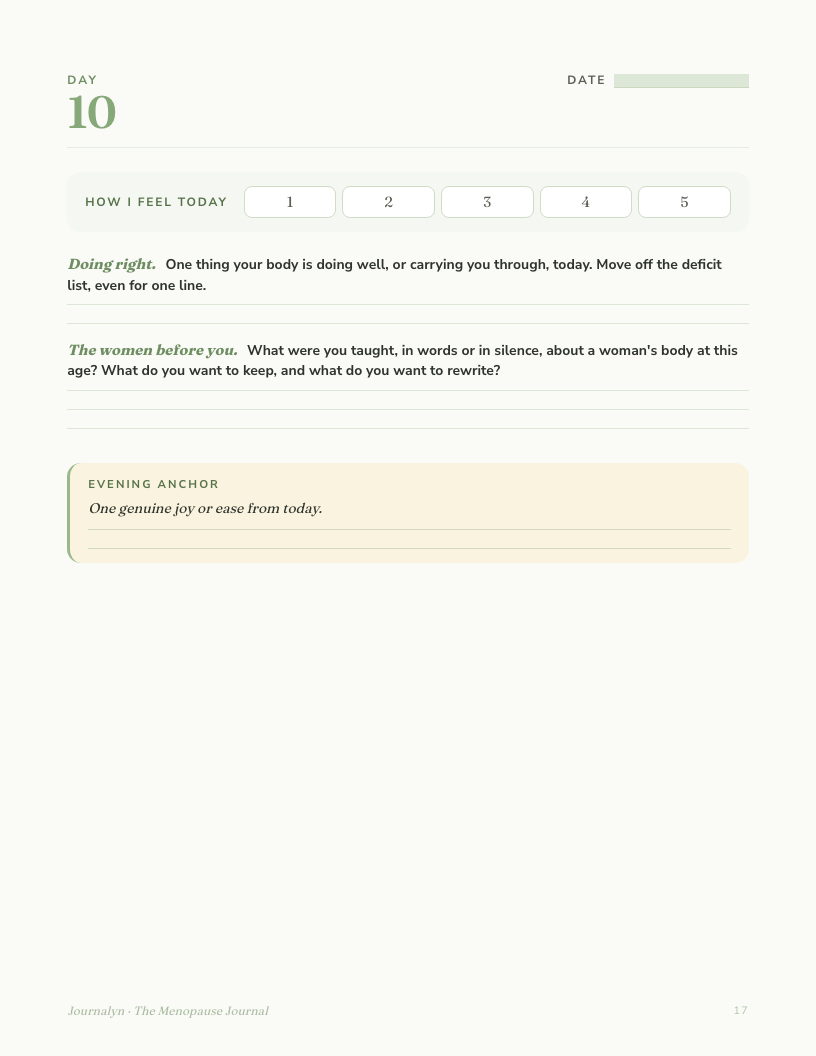
2. One thing my body is doing right
The cognitive research on menopause and wellbeing identifies deficit-focused attention as one of the strongest predictors of negative experience. When the dominant narrative about your body is what it is failing to do, that narrative becomes self-reinforcing. A daily practice of noticing what the body is still doing, making possible, carrying, and creating does not deny the symptoms. It refuses to let the symptoms be the whole story.
The body walked 3 miles. The body cooked dinner. The body stayed awake through a difficult conversation. The body woke up and tried again. These are not small things.
3. Hormone wisdom reflection
A weekly half-page for the clinical learning: what HRT or lifestyle change you tried, what you noticed, what the correlation seemed to be. Not a medical record, but the subjective experience of what works for your body, which no clinical trial can tell you because you are not a population average. After 3 months of weekly reflections, most women have a clearer picture of their own hormonal response than their doctor can provide.
4. Releasing and claiming pages
The most important pages in the journal. Two questions, answered slowly over weeks and months:
- What am I releasing from the previous chapter? (Roles that were assigned, not chosen. Obligations that accumulated without consent. The performance of smallness. The anxiety of other people's opinions.)
- What am I claiming in this one? (What I actually want. Who I actually am. The opinions I stopped expressing. The work I kept deferring. The version of myself I kept saving for later.)
These pages are not filled in once. They are returned to over months. The answers change as the fog of the transition clears.
5. Joy found today
One line, every day. Not a gratitude list, not an appreciation practice. Just: what was genuinely good today. Research on subjective wellbeing in midlife consistently finds that the ability to notice small positive moments is one of the strongest protective factors against depression during major life transitions. The practice builds the noticing muscle. After 60 days it becomes automatic.
6. HRT and lifestyle log
A practical tracking section: current medications and doses, any changes in the past 30 days, supplements, alcohol (which disrupts sleep and worsens hot flashes in many women), movement type and duration, and a correlation note: did this seem to help or worsen symptoms this week. The lifestyle log is the component most women find they want to expand after 2 to 3 months of use.
7. Weekly empowerment review
Ten minutes, once a week: what the body taught me this week. What I am letting go of. What I am carrying forward. One word for the woman I am becoming. Over 12 weeks, the weekly reviews become a document of a transformation. Most women who re-read their first and twelfth weekly reviews find they do not recognise the degree of change that happened in between.
Menopause journal vs perimenopause tracker
| Factor | Menopause journal | Perimenopause tracker |
|---|---|---|
| Primary focus | Identity, meaning, and empowerment alongside symptoms | Symptom variability and medical communication |
| Best used from | Mid-perimenopause through post-menopause | Early perimenopause symptoms through the transition |
| Cycle tracking | Not included (cycles have ended or are ending) | Full cycle log included |
| Identity work | Dedicated releasing and claiming pages | Minimal |
Frequently asked questions
Does keeping a menopause journal help with symptoms?
A journal does not reduce symptoms directly, but it does two things that make a significant difference. First, it turns vague discomfort into specific data: you stop saying "I feel terrible" and start saying "hot flashes are worse in the afternoon, correlate with caffeine, and peak in the week before my scheduled HRT dose." That data is useful to your doctor and gives you something actionable. Second, a journal that includes identity and meaning pages addresses the psychological dimension of menopause that symptoms-only tracking ignores, and which research consistently shows contributes significantly to overall quality of life in this transition.
Is a menopause journal the same as a perimenopause journal?
They serve related but different purposes. A perimenopause journal typically focuses on tracking the highly variable symptoms of the transition phase: irregular cycles, hot flashes, sleep disruption, mood changes, and correlating them with hormonal fluctuation. A menopause journal (for women at or past the final period) can include symptom tracking, but its more important function is often identity and meaning work: the reframing of this transition as a beginning rather than a decline, and the intentional construction of what comes next.
What should I write in a menopause journal daily?
The most useful daily practice takes about 10 minutes: a brief symptom check-in (hot flashes, sleep, mood, energy, brain fog), one thing your body did right or made possible today, a brief hormone or lifestyle note (HRT timing, supplements, exercise, alcohol), and one thing that was genuinely good today. Once a week, add a longer reflection: what the body taught me this week, what I am releasing from the old chapter, what I am claiming in the new one. That weekly reflection is where the most significant journaling happens.
At what age should I start a menopause journal?
Most women find a menopause-focused journal most useful from the mid-perimenopause phase onward, roughly 45 to 55 for most women. The Perimenopause Symptom Tracker is designed for the earlier, more variable transition phase. A menopause-oriented journal focused on identity and meaning is most valuable in the period around the final period and into the first years of post-menopause, when the identity shift is most active.
Can I journal about menopause if I had a surgical or medical menopause?
Yes. Surgical menopause (following hysterectomy or oophorectomy) and medical menopause (chemotherapy-induced) often trigger an abrupt transition that is psychologically more disorienting than natural menopause because there is no gradual preparation. A menopause journal is especially useful in these situations: the identity pages address the abruptness of the transition, and the symptom tracking is relevant regardless of how menopause was reached.
What is the difference between a menopause journal and just tracking hot flashes?
Hot flash tracking is one data point in a menopause journal. A complete menopause journal also addresses: the sleep disruption that is often more debilitating than hot flashes; the cognitive changes (brain fog, word-finding difficulties) that many women find alarming and that benefit from normalisation and tracking; the mood variability that responds to lifestyle intervention; and the identity dimension that hot flash tracking completely ignores. The women who report finding journaling most helpful for menopause are usually the ones using it for meaning-making, not just symptom logging.
E-E-A-T note
This article draws on published research on menopause, positive psychology, and midlife identity development. It is educational content, not medical advice. For menopause symptoms significantly affecting quality of life, please consult a menopause specialist or your GP.
Recommended for this topic:
- Printable Menopause Journal for Women , 34 pages: daily check-in, hormone wisdom, releasing and claiming pages, HRT log, weekly empowerment review.
- Menopause Toolkit : the journal plus identity workbook, hot flash and sleep log, and relationships guide.
- Perimenopause Symptom Tracker : for the earlier, variable transition phase.