Postpartum Journal Ideas:
10 Prompts for the Fourth Trimester
By Journalyn · · 7 min read
TL;DR
- The fourth trimester involves a profound identity shift (matrescence) that our culture has almost no language for.
- The most useful postpartum prompts address what does not get addressed elsewhere: identity, ambivalence, needs, and PPD awareness.
- Baby blues resolve within 2 weeks. Symptoms lasting longer may be PPD: worth naming and seeking support for.
- You do not have to feel only gratitude. A journal that only asks for highlights is not adequate for what the fourth trimester actually is.
The fourth trimester is the season that needs the most support and gets the least. A postpartum journal that only asks for baby highlights is missing the point entirely.
What postpartum journaling actually needs to hold
Most "postpartum journals" on the market are really baby memory books in disguise: first smile, first feed, first bath. These matter. They are not what we are talking about here.
A postpartum journal for the mother needs to hold the parts of new motherhood that have no cultural container: the identity disorientation of matrescence (who am I now?), the emotional ambivalence (I love this baby and I am also grieving my old life), the exhaustion that goes beyond tiredness, the needs that disappear into the baby's needs, and the window for recognizing postpartum depression before it becomes entrenched.
10 postpartum journal prompts across 5 categories
Daily check-in (2 prompts)
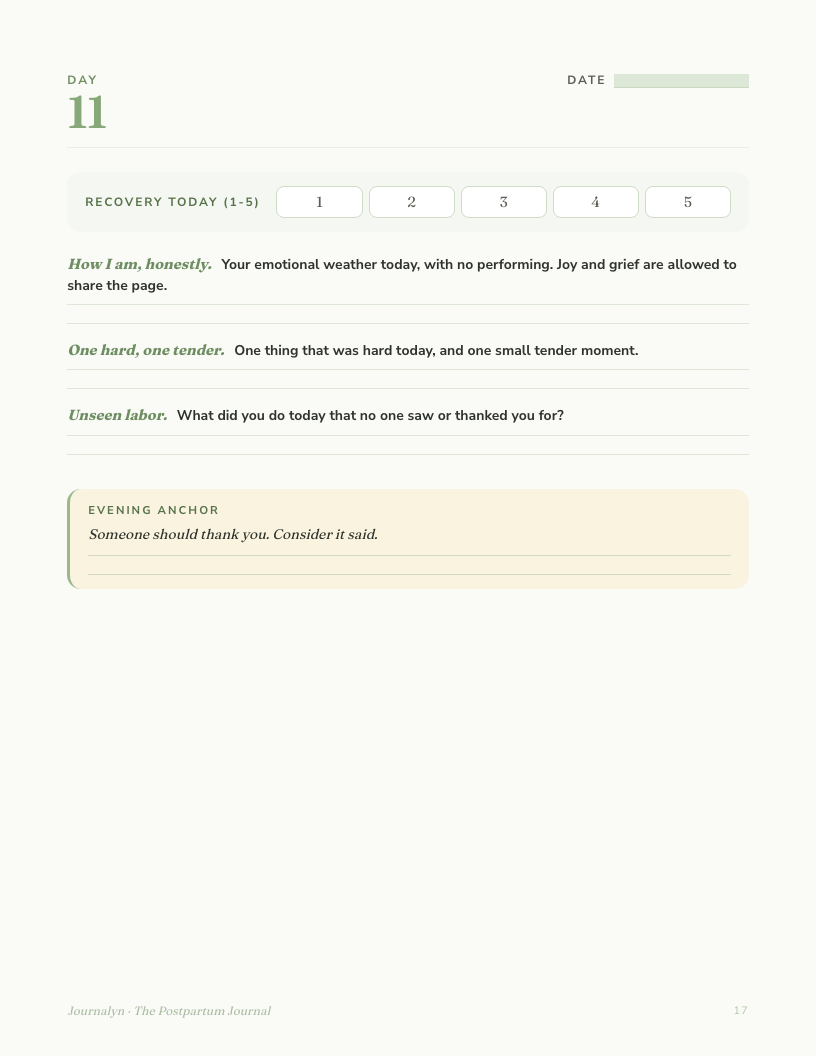
- Physical recovery today (1–5): what is healing, what still hurts, what surprised me about my body today.
- Emotional state today (1–5): what form did the hard take today, and what moment, however small, was tender or good.
Identity shift: matrescence (3 prompts)
The disorientation of becoming a mother is not a sign that something is wrong. It is the sign that something profound is happening.
- Who was I before? What part of that person do I most want to carry into this new life?
- What am I grieving about my old self or old life: without guilt for grieving it?
- What is motherhood giving me that I did not expect and did not know I needed?
Needs inventory (2 prompts)
You have needs. They do not stop because someone else's needs are louder.
- What do I need right now that I have not asked for? (Sleep, help, time alone, physical touch, connection, to be seen.)
- What is one specific, small ask I could make of my partner, family member, or friend this week?
PPD and PPA awareness (1 prompt)
Baby blues are common and normal. They peak around day 3 to 5 and resolve within 2 weeks. Symptoms lasting longer deserve attention.
- How have I been feeling over the last two weeks, honestly? Am I feeling better than I was, the same, or worse? Have I had thoughts that frightened me? (If yes to the last question: please contact your healthcare provider today.)
Returning to self (2 prompts)
Use these when the acute phase has lifted: whenever that is for you.
- What did I miss about myself during those early weeks? What do I want to reclaim, even in small ways?
- What does the life I want to build from here look like: as a mother, and as myself?
Baby blues vs postpartum depression: what to know
| Factor | Baby blues | Postpartum depression |
|---|---|---|
| Onset | Days 2–5 after birth | Any time in the first year |
| Duration | Resolves within 2 weeks | Persists beyond 2 weeks |
| Prevalence | Up to 80% of new mothers | Approximately 1 in 7 new mothers |
| Bonding | Usually intact | May be disrupted |
| Action needed | Support, rest, monitoring | Healthcare provider, treatment |
Frequently asked questions
What is the fourth trimester?
The fourth trimester is the first 12 weeks after birth, a term coined to acknowledge that the postpartum period is as significant a transition as the three trimesters of pregnancy, for both baby and mother. It involves profound physical recovery, hormonal upheaval, sleep deprivation, identity shift, and relational adjustment, all simultaneously. The term emerged from pediatric research (Harvey Karp) but has been increasingly applied to maternal experience as well.
What should I write in a postpartum journal?
The most useful postpartum journal sections cover the parts of new motherhood that get no cultural container: the identity shift (who am I now?), the emotional ambivalence (joy and grief and overwhelm at the same time), the physical recovery (too often ignored once the baby is healthy), the needs inventory (what do I need that I am not asking for?), and the baby blues vs PPD awareness (so you can name what you are experiencing and seek help if needed).
Is postpartum journaling safe if I have PPD?
Gentle journaling can be a supportive companion to PPD treatment, but it is not a substitute for professional support. If you are experiencing persistent sadness, loss of interest in your baby, intrusive thoughts, or symptoms lasting more than 2 weeks, please contact your healthcare provider. This journal is for the normal emotional difficulties of the fourth trimester, for clinical PPD, professional treatment is essential.
What is matrescence?
Matrescence is the developmental and psychological process of becoming a mother, coined by anthropologist Dana Raphael and brought to wider attention by perinatal psychiatrist Dr. Alexandra Sacks. Like adolescence, it involves neurological changes, hormonal shifts, and a profound identity reorganization. Unlike adolescence, it is almost never acknowledged culturally, which is why so many new mothers feel alone in the disorientation they experience alongside love.
When should I start a postpartum journal?
Any time. Day one, week four, or month six. Earlier is better for the physical recovery tracker and baby blues awareness page. The identity and returning-to-self prompts are useful at any point in the first year. There is no wrong time to begin.
What is a printable postpartum journal?
A printable postpartum journal is a PDF you download and print at home. It contains structured pages for the emotional and physical experience of the fourth trimester: daily check-ins, identity prompts, a baby blues vs PPD awareness page, a needs inventory, partner communication pages, and quiet returning-to-self exercises. Fully private, no app required.
Written by the Journalyn team. We design printable journals for women. This article draws on matrescence research (Raphael, Sacks) and postpartum mental health research. It is for educational purposes. For PPD, PPA, or postpartum psychosis, please contact your healthcare provider immediately.
For the fourth trimester
Printable Postpartum Journal
34 pages with all 10 prompts above built in: daily check-in, identity shift prompts, needs inventory, PPD awareness page, partner communication, feeding log, and returning-to-self pages. $14.99, instant PDF download.
View the journal →Or see the Postpartum Toolkit (4 PDFs, $27.99) which adds a PPD and PPA awareness workbook, a new identity workbook, and a 6-week physical recovery tracker.