“I don't feel like myself lately.”
Printable Body Image Journal for Women (30 Pages)
A printable body image journal built on body neutrality and self-compassion research: prompts for noticing and reframing appearance-focused thoughts, a media and comparison influence tracker, body appreciation pages that focus on function rather than aesthetics, a values clarification exercise to reconnect with what actually matters to you, and a weekly check-in on your relationship with your body. Thirty pages for the work of making peace with the body you live in.
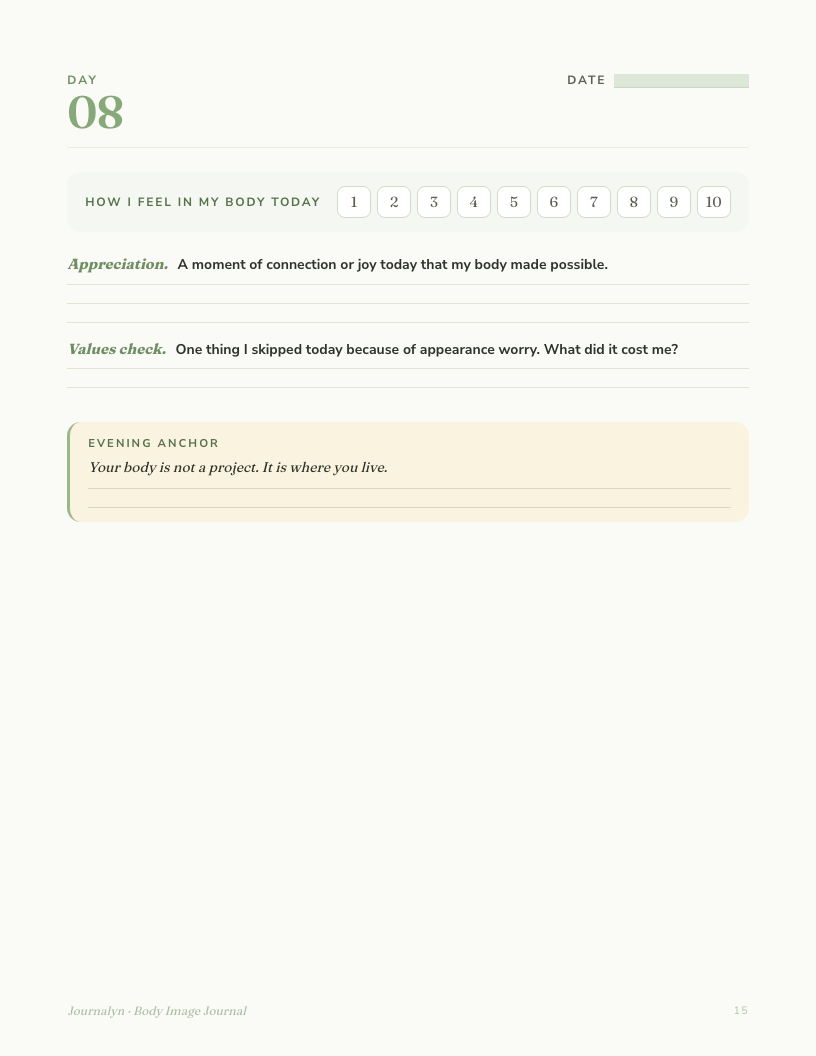
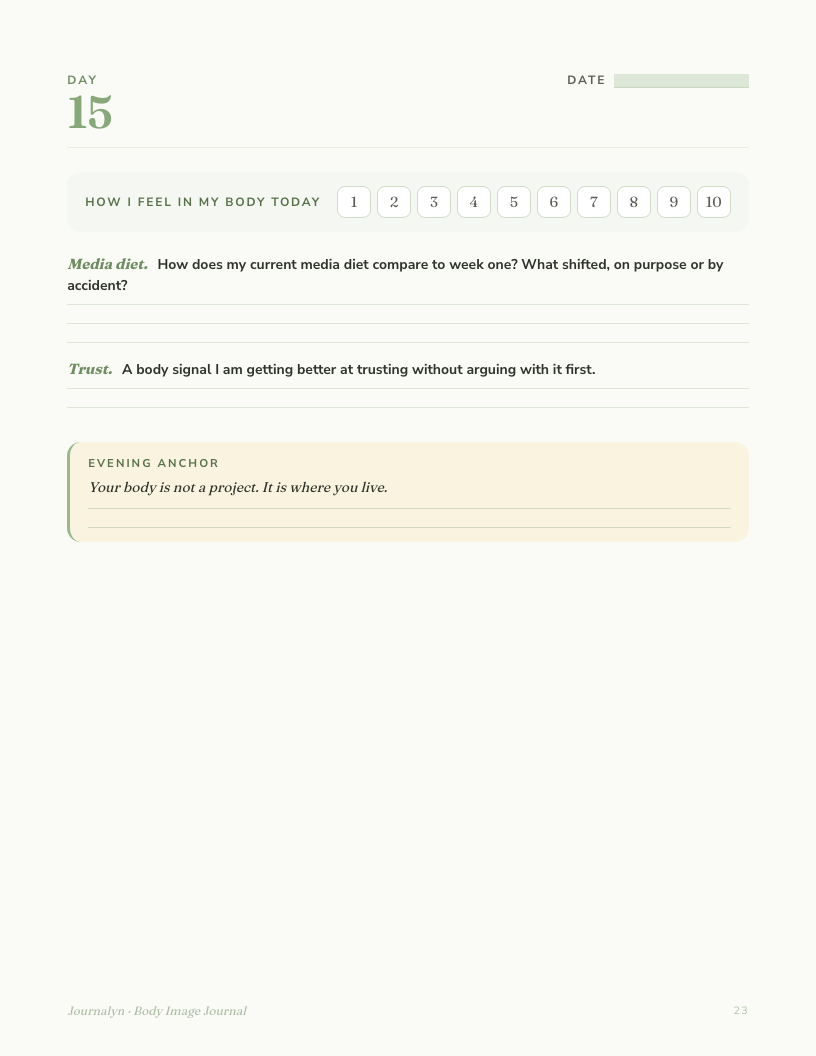
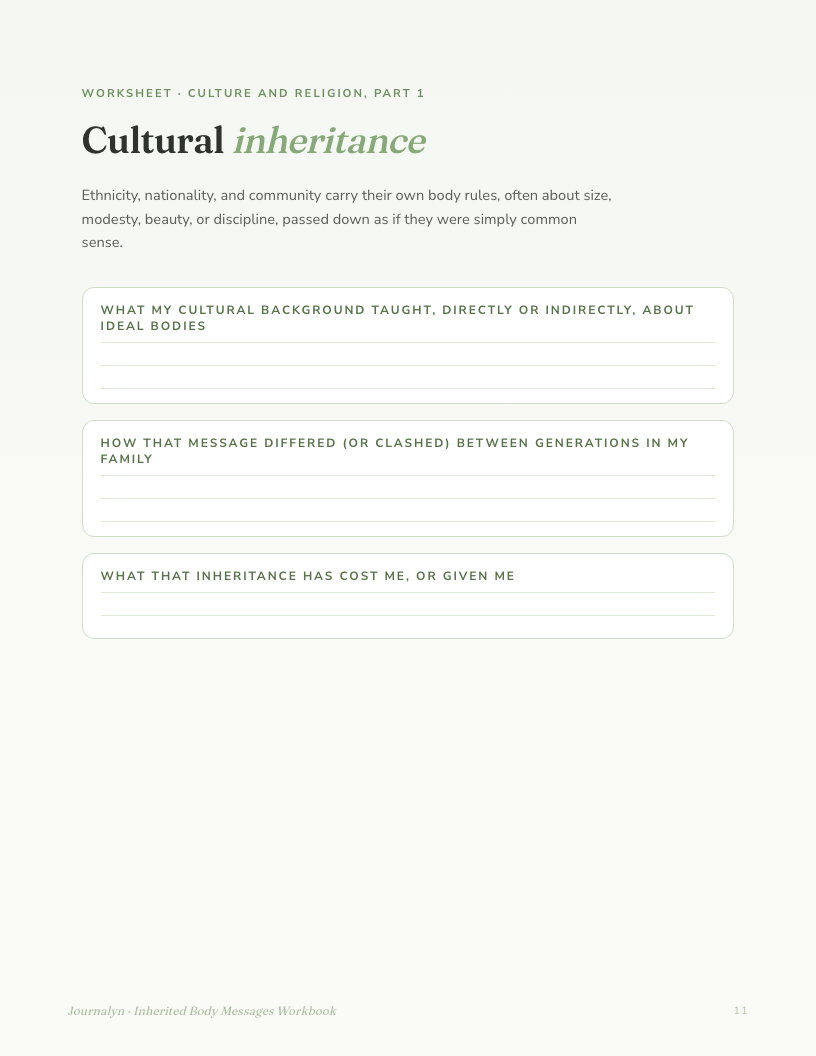
Real pages from this PDF, exactly as they print.
Save $32
Body Image Toolkit: this journal plus 3 more PDFs (inherited body messages workbook, intuitive movement guide, food and body peace journal) for $27.99.
USD · One-time purchase · Instant PDF
- 30 pages
- US Letter (8.5 x 11 in) and A4 both included
- Personal use; reprint as often as you need
Built on widely accepted research. Not a substitute for therapy or medical care.
What is inside
- Appearance thought log, noticing body-critical thoughts: the trigger, the thought, the emotion, and the reframe
- Media and comparison tracker: which accounts, images, or environments trigger comparison, and a social media audit
- Body neutrality prompts: moving from "I love my body" (often inaccessible) to "my body does remarkable things" (usually true)
- Body appreciation pages, what my body makes possible: movement, sensation, presence, connection
- Values clarification exercise: what actually matters to me, and how much of my current attention on my body serves those values
- Inherited messages inventory: what beliefs about bodies did I absorb from my family, culture, or media, and which ones belong to me
- Weekly body relationship check-in, 3 questions: how have I treated my body this week, what did my body need that I gave it, one thing I want to do differently
How you use it
- 01Print the pages you needUS Letter or A4, both included. Black and white is fine; the pages are designed for it.
- 02Start with one pageFifteen minutes, a pen, no screen. You do not have to do it in order or every day.
- 03Reprint whenever you needIt is yours forever. A fresh copy for a new month, a new situation, or a bad week.
Format details
| Pages | 30 pages |
| Paper sizes | US Letter (8.5 x 11 in) and A4 both included |
| Format | PDF, instant download |
| License | Personal use; reprint as often as you need |
| Delivery | Instant download after purchase |
Who this is for
Body image is not about how your body looks. It is about the relationship you have with the body you live in, and for most women, that relationship was shaped by forces outside their control before they were old enough to evaluate them.
This journal is not about loving your body (a goal that can feel as impossible as the appearance goals it replaces). It is about body neutrality: shifting from a relationship defined by how your body looks to one defined by what it does, how it feels, and how it serves your actual values.
For women who spend significant mental energy on appearance concerns that undermine their quality of life. For women recovering from disordered eating (this journal is supplement to, not a replacement for, professional treatment in that case). For women who want to make peace with aging, with bodies that have changed after illness or childbirth, or with bodies that simply look like real human bodies in a culture that prefers otherwise.
Body neutrality journal vs body positivity content
| Factor | Body neutrality journal | Body positivity content |
|---|---|---|
| Goal | Peaceful relationship with your body as it is | Love and celebrate your body (often feels inaccessible) |
| Appearance focus | Reduces appearance-based thinking over time | Often still centres appearance (positively) |
| Research basis | Body neutrality and self-compassion research | Social movement, not clinical framework |
| Sustainability | Neutral is more achievable and stable than positive | Positivity can feel performative on hard days |
| Privacy | Private paper practice | Public-facing social content |
Frequently asked questions
Tap any question to see the answer.
What is body neutrality and how is it different from body positivity?
Body positivity asks you to love and celebrate your body. Body neutrality asks you to hold your body without strong positive or negative judgment: your body is the vehicle you live in, and its value is not determined by how it looks. For many women, body neutrality is more achievable because it does not require generating positive feelings about an appearance that they have been trained to criticize. Research by Tracy Tylka and colleagues on body appreciation supports body neutrality-adjacent approaches as more sustainable than appearance-focused positivity.
Is this journal appropriate for someone recovering from an eating disorder?
With care. The journal does not include any weight, food, or calorie tracking. It focuses on thoughts, values, and the relationship with the body rather than appearance or food behaviors. For someone in active eating disorder recovery, please use this only as a complement to professional treatment and with your therapist's awareness.
What is the appearance thought log?
The appearance thought log is a structured exercise for noticing and working with body-critical thoughts: what triggered the thought, what the thought was, what emotion it produced, and a reframe. Over time it builds awareness of triggers and patterns, which is the first step in changing the relationship with those thoughts.
How often should I use this journal?
The appearance thought log and media tracker are used as needed (when a thought or trigger occurs). The body appreciation pages and values clarification are best done once a week. The weekly check-in takes about 5 minutes.
How is it delivered?
Instant digital download. After payment, you receive a PDF link. Print at home.
What paper size does it print on?
Both US Letter (8.5 by 11 in) and A4 are included in the same PDF.
Designed by the Journalyn team. We design printable journals for women. This journal draws on body neutrality research, self-compassion frameworks, and body image cognitive work. It is a self-care tool. For disordered eating or clinical body dysmorphia, please work with a licensed therapist.
More from this topic
Related reading
- Body Image Toolkit (4-PDF bundle, $27.99) (save $31.97 with the full system).
- Printable Self-Love Journal ($14.99) (the broader self-worth practice this journal sits within).
- Printable Inner Child Healing Journal ($14.99) (for body image wounds that trace to childhood).
- Browse all Journalyn articles