ADHD Journal for Women:
How Structured Journaling Helps
By Journalyn · · 8 min read
TL;DR
- Standard planners fail ADHD brains because they assume consistent executive function and ignore task initiation, energy variability, and RSD.
- An ADHD journal tracks 6 things standard planners miss: energy peaks, task initiation barriers, hyperfocus sessions, RSD episodes, time estimates vs reality, and wins.
- The wins and evidence log is as important as any other section: the ADHD narrative of failure is almost always inaccurate.
- ADHD journals work best as light-touch daily tools (10 minutes), not full-session commitments.
The reason standard planners do not work for ADHD is not a willpower problem. It is a design problem: they are built for a different brain.
What standard planners get wrong about ADHD
Standard planners are built on one assumption: that you can look at a task, decide to do it, and start. For most neurotypical people, this is accurate enough. For the ADHD brain, it describes only half the problem, and not the hard half.
The hard half is task initiation: the friction between knowing you need to do something and actually beginning it. Task initiation is one of the six executive function domains most consistently impaired by ADHD (alongside working memory, cognitive flexibility, inhibitory control, planning, and emotional regulation). A planner with a to-do list assumes initiation is automatic. For the ADHD brain, initiation is the job.
Standard planners also assume consistent energy and focus throughout the day, provide no mechanism for hyperfocus (the ADHD brain's most powerful state), ignore rejection sensitive dysphoria entirely, and treat incomplete tasks as failures rather than as data points about what conditions the ADHD brain needs to engage.
6 things an ADHD journal tracks that standard planners miss
1. Energy and focus variability
ADHD energy and focus are genuinely variable in ways that neurotypical energy is not. Tracking AM and PM energy (1–5) and noting your peak focus window each day reveals your personal pattern: whether your best cognitive hours are morning, mid-afternoon, or evening. Over 2 to 3 weeks, this data lets you schedule your most demanding tasks in your actual peak window rather than the assumed one.
2. Task initiation barriers
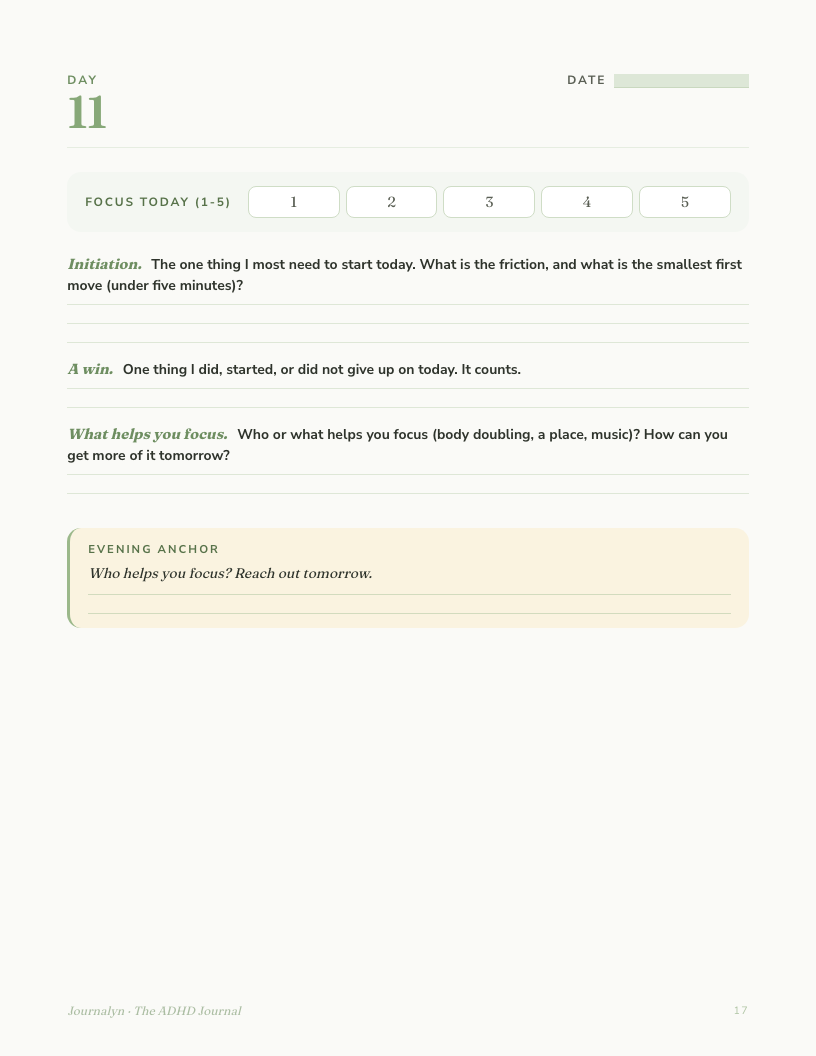
A task initiation log asks three questions: what did I need to do, what blocked me from starting, and what finally got me started. After a few weeks, patterns emerge. Common ADHD initiation barriers: unclear first step, boring or low-stimulation task, no deadline pressure, wrong environment, wrong time of day. When you know your patterns, you can engineer around them rather than fighting them with willpower.
3. Hyperfocus sessions
Hyperfocus is the ADHD brain's most powerful state: and one of its most mismanaged. When the ADHD brain hyperfocuses, it can produce extraordinary work in compressed time. When it hyperfocuses on the wrong thing, it loses hours. A hyperfocus session log captures what triggered the state, what was produced, and how long it lasted. Over time it builds a map of which conditions reliably produce hyperfocus on productive work, which you can then deliberately engineer.
4. RSD processing
Rejection sensitive dysphoria arrives as a sudden, intense emotional crash in response to perceived rejection, criticism, or failure. The key word is perceived: it does not require actual rejection, only the interpretation that rejection occurred or might occur. An RSD processing page asks: what triggered it, what story am I telling myself, what is actually true here, and what do I need right now. This does not stop RSD, but it shortens recovery time and prevents the story from calcifying into self-belief.
5. Time estimates vs reality
Time blindness makes planning unreliable because the estimated durations are wrong. A simple time audit, writing down how long you thought a task would take and how long it actually took, builds calibration over weeks. Most ADHD women discover they consistently underestimate by 2 to 3 times. Once you have your personal calibration factor, you can add buffer time by design rather than hoping this time will be different.
6. Wins and evidence log
The ADHD brain is wired to remember failures and discount successes. This is not a character flaw: it is a well-documented pattern in ADHD cognitive style, related to working memory and reward processing differences. A daily wins log (3 things I completed, showed up for, or did not give up on) builds a running counter-narrative. On the days the inner critic says you never follow through, the log says otherwise.
ADHD journal vs standard planner: a direct comparison
| Dimension | ADHD journal | Standard planner |
|---|---|---|
| Task initiation | Dedicated log with barrier identification | To-do list (assumes initiation is not the problem) |
| Energy variability | AM/PM energy tracking, peak focus window | Same template every day |
| RSD | Dedicated processing pages | Not acknowledged |
| Hyperfocus | Session log to capture and analyze | Not supported |
| Missed tasks | Barrier data: what got in the way | Visual evidence of failure |
Frequently asked questions
Why do standard planners not work for ADHD?
Standard planners assume consistent executive function: that you can look at a task, decide to do it, and start. For ADHD brains, task initiation is the barrier, not the task itself. Standard planners also assume consistent energy and focus, ignore emotional regulation challenges like RSD, and provide no mechanism for the variable motivation and hyperfocus patterns that characterize ADHD. They are designed for neurotypical executive function and feel like evidence of failure when the ADHD brain cannot use them as intended.
What is RSD and why does it need its own journal section?
Rejection sensitive dysphoria (RSD) is an intense emotional response to perceived or actual rejection, criticism, or failure. It is strongly associated with ADHD and can be one of the most disabling aspects of the condition. The emotional intensity is genuinely disproportionate to the situation from the outside, but it is not an overreaction, it is a different neurological response to social pain. RSD needs its own journal section because it is specific, it has distinct processing needs (naming the trigger, separating the story from the fact, identifying the underlying need), and most ADHD resources barely mention it.
Can journaling replace ADHD medication?
No. Medication addresses the neurological substrate of ADHD. Behavioral and structural tools like journals address the external scaffolding that supports executive function. Both are valuable; neither replaces the other. Many women find that structured behavioral tools work best in combination with, or as a complement to, medication and therapy.
What is time blindness?
Time blindness is the difficulty the ADHD brain has accurately perceiving and estimating time. This includes underestimating how long tasks take, failing to sense time passing while absorbed in a task, and poor planning for future time commitments. It is not carelessness or disrespect, it is a documented executive function difference. Tools that help: time audits (actual vs estimated task durations), visual timers, and structured transition time between tasks.
How is an ADHD journal different from an anxiety journal?
Anxiety journals focus on CBT thought work, self-compassion, and behavioral activation. ADHD journals focus on energy variability, task initiation barriers, hyperfocus capture, RSD processing, and time management. There is significant overlap (ADHD and anxiety co-occur in roughly 50% of cases), but the tools address different mechanisms. An anxiety journal alone will not help with task initiation; an ADHD journal alone will not fully address the cognitive distortions of clinical anxiety.
What is a printable ADHD journal?
A printable ADHD journal is a PDF you download and print at home. It contains structured daily pages designed for the ADHD brain: energy and focus tracking, task initiation log, hyperfocus session capture, RSD processing pages, a time-blocking daily page, and a wins and evidence log. Paper-based, fully private, no app required.
Written by the Journalyn team. We design printable journals for women. This article draws on ADHD research including executive function, RSD, time blindness, and gender differences in ADHD presentation. For ADHD diagnosis or treatment, please see a licensed psychiatrist or psychologist.
Built for your brain
Printable ADHD Journal for Women
34 pages with all 6 sections: daily energy and focus tracker, task initiation log, hyperfocus session log, RSD processing pages, time-blocking daily page, and wins and evidence log. $14.99, instant PDF download.
View the journal →Or see the ADHD Toolkit (4 PDFs, $27.99) which adds an executive function workbook, an ADHD relationships guide, and a time management system built for time blindness.