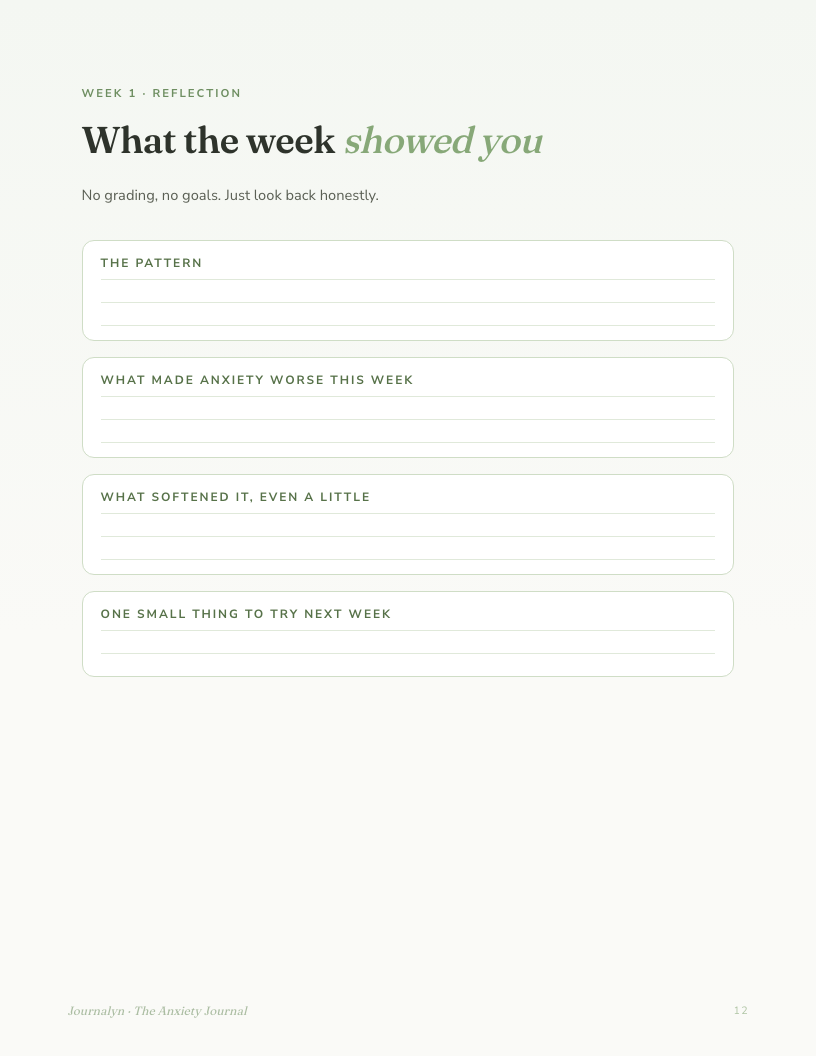
How to Start an Anxiety Journal (with Free Printable Prompts)
Updated May 24, 2026 · 7 min read
To start an anxiety journal, pick a simple format (a guided printable or a plain notebook), choose a consistent time each day, and write down each worry, rate its intensity, and challenge it gently. Most beginners feel calmer within their first 5-to-10-minute session.
What is an anxiety journal?
An anxiety journal is a dedicated space to write down anxious thoughts so they live on paper instead of looping in your head. The act of naming a worry makes it concrete, smaller, and easier to question.
Unlike a general diary, an anxiety journal is structured around your worries: what triggered them, how intense they feel, and what you can actually do about them. That structure is what turns venting into relief.
How to start an anxiety journal in 5 steps
Starting is simple. The trick is to keep it small enough that you will actually do it tomorrow. Follow these five steps.
- Choose your format. A guided printable with prompts, or a blank notebook if you prefer freedom. Beginners usually start faster with prompts.
- Pick a consistent time. Anchor it to something you already do, like morning coffee or before bed. The cue builds the habit.
- Name and rate the worry. Write the specific thought, then rate its intensity from 1 to 10. Numbers make anxiety feel finite.
- Question it gently. Ask: what is the evidence? Is this a fact or a fear? What would I tell a friend who felt this way?
- Close with one calm anchor. Write one small next action and one thing you are grateful for. Ending on calm trains your nervous system.
Free anxiety journal prompts to try tonight
If the blank page feels intimidating, start with these prompts. Pick one. You do not need to answer them all.
- What am I worried about right now, in one sentence?
- On a scale of 1-10, how intense is this worry? Why that number?
- What is the worst case, and how likely is it really?
- What is one thing within my control today?
- When did I feel calm recently, and what helped?
- What would I say to a friend facing this exact worry?
- Three things that went okay today, however small.
Guided printable vs. blank notebook: which is better?
Both work. The right choice depends on how much structure you want. Here is a quick comparison.
| Factor | Guided printable | Blank notebook |
|---|---|---|
| Best for | Beginners | Experienced journalers |
| Blank-page freeze | Removed by prompts | Common at first |
| Structure | High (CBT-style flow) | You build your own |
| Time to first entry | Under 2 minutes | Varies |
How long until journaling helps?
Many people notice a small drop in tension within a single session, because writing offloads the worry. The bigger benefits (fewer spirals, faster recovery from anxious moments) tend to build over two to four weeks of regular practice.
When to seek extra support
If anxiety regularly disrupts your sleep, work, or relationships, or if you feel unsafe, please reach out to a licensed therapist or doctor. A journal is a helpful companion to professional care, not a replacement for it.
Frequently asked questions
Does journaling actually help with anxiety?
Yes. Putting anxious thoughts on paper externalizes them, which lowers the mental load and helps you see distortions more clearly. Many people feel calmer within a single 5-10 minute session, and a regular habit compounds the effect over weeks.
How often should I write in an anxiety journal?
Consistency matters more than length. A few minutes most days beats one long session a week. Many beginners do best with a short morning brain-dump and a brief evening reflection.
What should I write about when I feel anxious?
Name the worry, rate its intensity from 1 to 10, ask what evidence supports or contradicts it, and write one small action you can take. Closing with one thing you are grateful for shifts your nervous system toward calm.
Is an anxiety journal a substitute for therapy?
No. Journaling is a self-help tool that complements professional care. If anxiety disrupts daily life, sleep, or relationships, please speak with a licensed therapist or doctor. A journal can make those conversations more productive.
Should I use a guided printable or a blank notebook?
Beginners usually start faster with a guided printable because the prompts remove the blank-page freeze. A blank notebook offers more freedom once journaling is already a habit. Many people use both.
Written by the Journalyn team. We design and test printable journals for women, and we drafted these prompts using the same CBT-informed structure we build into our anxiety journal printables. This article is for general wellbeing and is not medical advice.