How to Start a Gratitude Journal (5-Step Guide + 10 Prompts)
Updated May 26, 2026 · 7 min read
A gratitude journal is a notebook or printed page where you write down things you're thankful for, usually 3–5 per day, in just a few minutes. Done consistently, it trains your brain to notice what's already good in your life, even on hard days.
What is a gratitude journal?
A gratitude journal is a simple, intentional practice of writing down what you're thankful for, from big moments to small ones like a quiet cup of tea or a kind word from a stranger. Unlike a diary, it's not about recording everything that happened. It's about training your attention toward what's good.
Research from psychologist Robert Emmons found that people who wrote gratitude entries consistently reported higher life satisfaction and fewer physical complaints than those who didn't. Most people start noticing a shift within two to three weeks of daily practice.
How to start a gratitude journal in 5 steps
You don't need a special notebook or a lot of time. Here's what to do on day one.
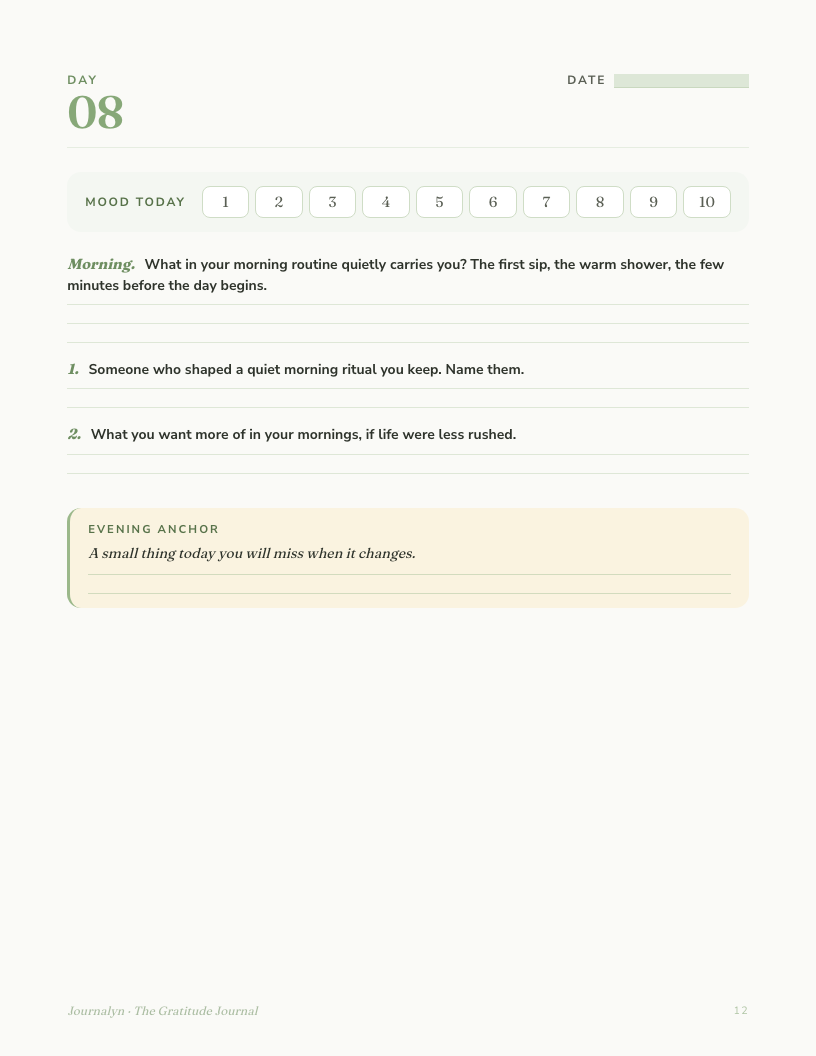
- Choose a format. Paper beats phone for this practice. No notifications, no apps competing for your attention. A plain notebook works. So does a printable gratitude journal page.
- Pick a consistent time. Morning or evening both work (see the comparison below). What matters is doing it at the same time every day, tied to an existing habit like your morning coffee or your wind-down routine.
- Write 3 specific things. Not "my family" but "my sister texted to check on me today." Specificity is what makes it feel real instead of rote.
- Add one sentence about why. "I'm grateful for the quiet walk this morning because it was the first time this week I wasn't rushing." The why deepens the feeling.
- Show up tomorrow. The first week is habit-building. The second week is where you start to notice the shift.
10 gratitude journal prompts for when you're stuck
"Coffee, family, health" is a fine start, but these prompts go deeper when the habit starts to feel automatic.
- What's one small thing that went right today?
- Who made your life easier this week, and how?
- What's something about your body you're grateful for today?
- What's a memory from this month that made you smile?
- What do you have now that you once hoped for?
- What challenge are you slowly getting through?
- What's something in your home that comforts you?
- Who in your life do you not thank enough?
- What simple pleasure did you experience today?
- What are you looking forward to, however small?
Morning vs evening: which time is better?
Both have real benefits. The right time is the one you'll actually keep.
| Factor | Morning | Evening |
|---|---|---|
| Effect on the day | Sets an intentional, positive tone | Reviews and closes the day well |
| What to write | What you're already grateful for, what you're anticipating | What actually went well that day |
| Pairs well with | Coffee, breakfast, before the rush starts | Wind-down routine, before sleep |
| Research benefit | Primes attention toward positive events | Consolidates positive memories before sleep |
| Best for | People who feel anxious or scattered in the morning | People who replay the day before sleeping |
How long should a gratitude journal entry be?
Short. Really short. Three things, one sentence of why for each: about 5 minutes. Length is not the point. Regularity is.
A 5-minute entry every day beats a 30-minute entry once a week, every time. If you want to add a bit more, include one thing you're looking forward to, or one person you'd like to acknowledge. Keep it light enough that it never feels like homework.
Frequently asked questions
What do you write in a gratitude journal?
Write 3–5 specific things you are grateful for: people, moments, or small pleasures from that day or week. Add one sentence about why each mattered. Avoid vague entries like "my health"; try "I walked for 20 minutes today and my knees didn't hurt." Specificity is what makes the practice feel real.
How often should you write in a gratitude journal?
Daily is ideal for building the habit, but 3–4 times a week still produces meaningful results. Consistency matters more than volume. A short entry most days outperforms a long entry once a week.
Does gratitude journaling actually work?
Research consistently shows it shifts attention toward what is going well, reduces low-level anxiety, and improves sleep quality over time. It works best as a complement to other self-care, not a replacement for professional support when that is needed.
When is the best time to write, morning or evening?
Both work. Morning primes your attention for the day ahead; evening consolidates positive memories before sleep. The best time is whichever one you will actually keep. See the comparison table in this article for more detail.
How long should a gratitude journal entry be?
Five minutes is enough. Write 3–5 things and one sentence of why for each. Shorter entries done consistently outperform long entries done occasionally.
Written by the Journalyn team. We design printable journals and self-care workbooks for women, including a dedicated gratitude journal built around this exact daily practice. This article reflects the prompting framework we use in our own products.