What Is Shadow Work? A Beginner's Guide + Printable Workbook
Updated May 24, 2026 · 8 min read
Shadow work is the practice of exploring the parts of yourself you tend to hide, deny, or feel ashamed of (your "shadow") so you can understand and integrate them. Done gently, it builds self-acceptance and reduces the automatic reactions that quietly run your life.
Where does the term "shadow" come from?
The idea comes from the psychologist Carl Jung, who used "the shadow" to describe the parts of the personality we push out of awareness: traits, desires, or memories we judge as unacceptable.
Those parts do not disappear. They surface as overreactions, harsh self-talk, or patterns we repeat without knowing why. Shadow work brings them into the light so they lose their hidden power.
How to start shadow work in 4 steps
You do not need special training to begin. Just honesty and a little courage. Move through these four steps slowly.
- Notice a strong reaction. Irritation, jealousy, or shame is a doorway. The intensity points to something unexamined.
- Get curious, not critical. Ask "what is this really about?" instead of judging yourself for feeling it.
- Trace its origin. When did you first feel this way? Whose voice does the inner criticism sound like?
- Offer compassion. Speak to that younger or hidden part of you the way you would comfort a friend. Integration grows from acceptance.
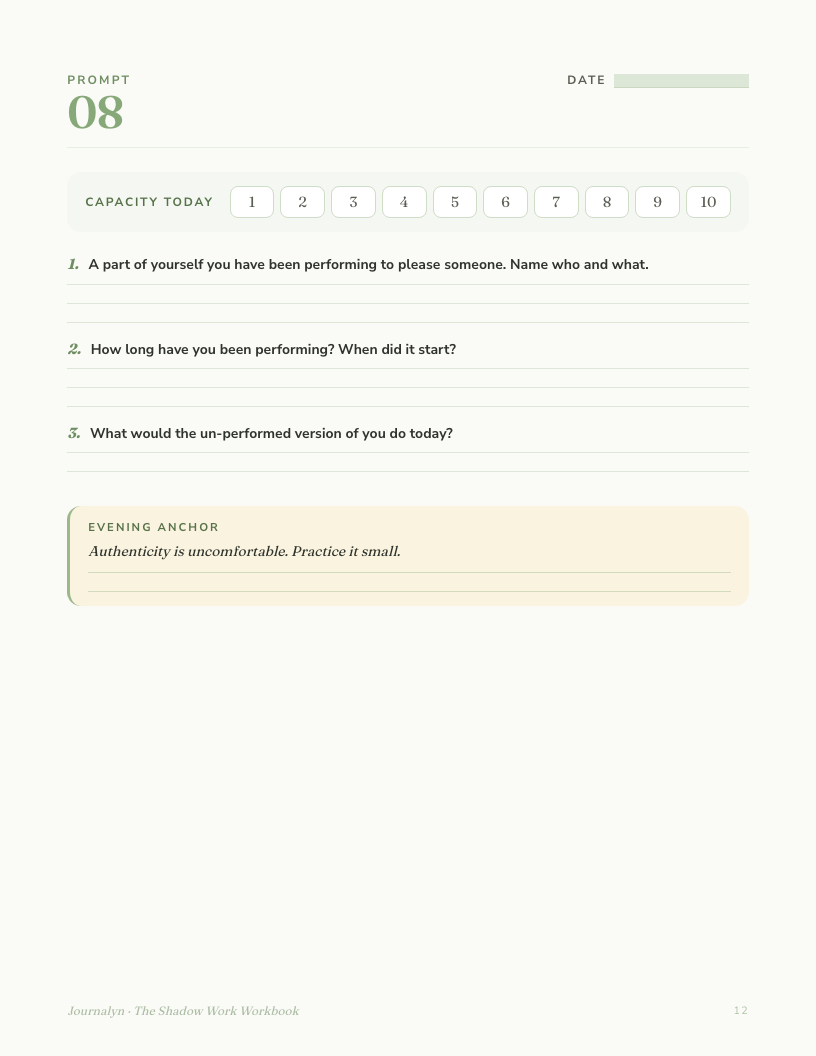
10 shadow work prompts for beginners
Choose one prompt per session. Sit with it rather than rushing to an answer.
- What trait in others irritates me most, and where do I show it too?
- What am I most afraid people would think if they really knew me?
- Whose approval am I still chasing, and why?
- What emotion was I not allowed to express as a child?
- When do I feel like I have to earn love?
- What am I pretending not to know about a relationship?
- What would I do if I believed I was already enough?
- What part of myself do I hide in front of others?
- What recurring pattern keeps showing up in my life?
- What would self-forgiveness look like for me today?
Shadow work vs. regular journaling: what's the difference?
They overlap, but their intent and depth differ. This table makes the contrast clear.
| Factor | Shadow work | Regular journaling |
|---|---|---|
| Focus | Hidden, rejected parts of self | Daily events and feelings |
| Emotional depth | High (can be intense) | Light to moderate |
| Goal | Integration and acceptance | Expression and record-keeping |
| Pace | Slow, one theme at a time | Daily, free-flowing |
Is shadow work safe?
For most people, gentle shadow work through journaling is safe and rewarding. The key is to go slowly, keep sessions short, and rest between them.
When to involve a professional
If you have experienced trauma, or if a session brings up overwhelming emotion, pause and consider doing this work alongside a licensed therapist. Shadow work supports healing best when you feel resourced and safe.
Frequently asked questions
What is shadow work in simple terms?
Shadow work is the practice of exploring the parts of yourself you hide, deny, or feel ashamed of (your "shadow") so you can understand and integrate them. The goal is self-acceptance and fewer automatic reactions, not fixing something broken.
Is shadow work safe to do alone?
For most people, gentle shadow work through journaling is safe and beneficial. Go slowly, keep sessions short, and stop if you feel overwhelmed. If you have a history of trauma, it is best done alongside a licensed therapist.
How do I start shadow work as a beginner?
Start by noticing a strong emotional reaction (irritation, jealousy, or shame) and ask what it is pointing to. Then use a written prompt to explore where that pattern began. A structured workbook keeps the process safe and contained.
How is shadow work different from regular journaling?
Regular journaling records your day and feelings. Shadow work deliberately turns toward the uncomfortable, hidden, or rejected parts of yourself to understand and integrate them, which makes it deeper and more targeted.
How often should I do shadow work?
Quality matters more than frequency. One focused session a week is plenty for most beginners. Shadow work can be emotionally tiring, so rest between sessions and let insights settle.
Written by the Journalyn team. We design printable healing and self-discovery workbooks for women, and these prompts are drawn from the same Jungian-informed framework we build into our shadow work workbook. This article is educational and is not a substitute for therapy.