Grief Journal for Women:
5 Prompts for When Words Are Hard
By Journalyn · · 7 min read
TL;DR
- Structured grief journaling outperforms blank-page journaling because it redirects away from rumination.
- The most useful sections: daily check-in, memory preservation, grief waves tracker, anger release, and quiet rebuilding prompts.
- On impossible days, a check-in number alone counts. Partial use is still useful.
- Grief journals are for any kind of loss, not only death.
A grief journal is most useful when it has enough structure to begin from on the days when you have nothing left, and enough space to hold whatever comes when you do.
Why the blank page is hard in grief
Most people know journaling might help with grief. Most people also find themselves staring at a blank page unable to start. This is not a failure of motivation. Grief produces a specific kind of cognitive overwhelm: too many feelings, not enough language, and an awareness that whatever you write will be inadequate to what you are carrying.
Structured prompts solve the starting problem. They give the pen somewhere to land before you have decided what to say. The structure does not prescribe what you feel: it just removes the decision of where to begin, which is often the hardest part.
There is also a risk with unstructured grief journaling: rumination. Research on grief and rumination by Nolen-Hoeksema and others suggests that repetitive, unresolved focus on distressing content can prolong grief responses. Structured journaling redirects toward memory preservation, meaning-making, and gentle forward movement, not suppressing the grief, but giving it somewhere useful to go.
5 grief journal prompts to start with
1. The check-in
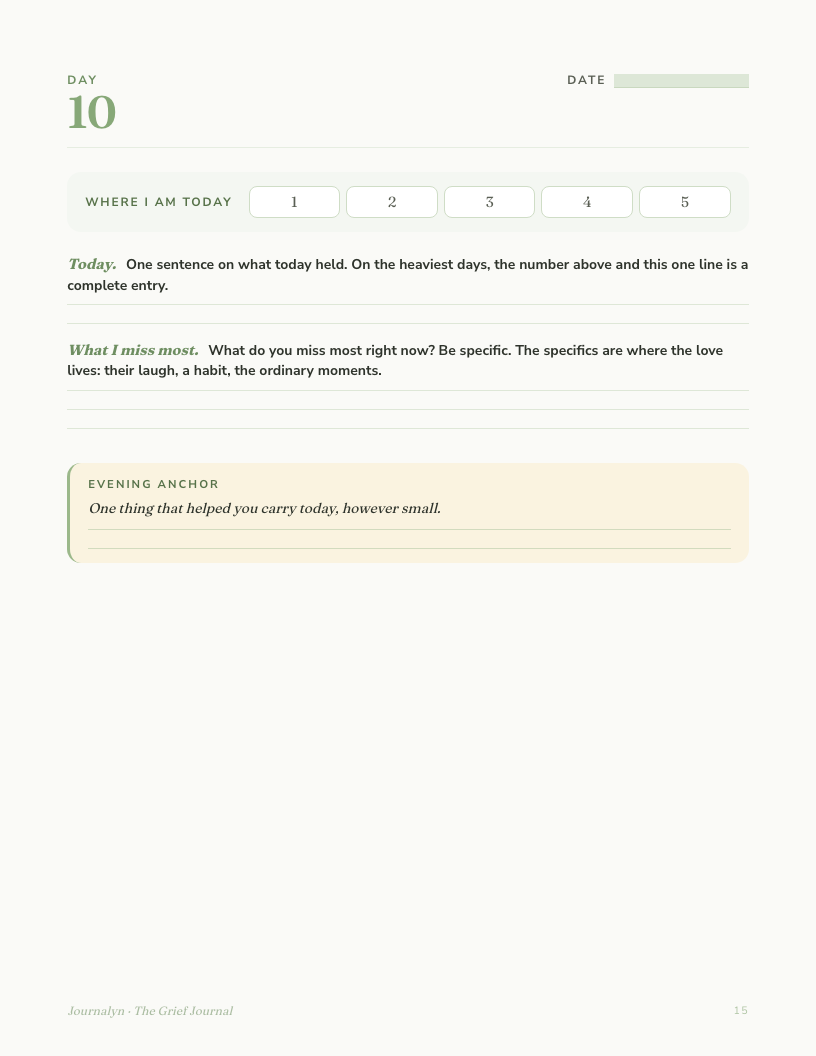
Where are you today, on a scale of 1 to 5? What is the grief feeling like right now: is it heavy and still, or moving and restless? What do you need today that you have not asked for?
On hard days, only the number matters. Date the page, write the number, close the journal. That is enough. The practice of witness, marking that this day existed and this is where you were, is its own act of care.
2. One thing I do not want to forget
Write one specific memory: their laugh, a habit they had, something they always said, a smell that was theirs, the way they moved in a room. Not a tribute, a detail. The small specific things are what blur first and what matter most to preserve.
This prompt is most urgent in the early weeks after a loss, when the details are still vivid. Return to it as often as something surfaces that you want to keep.
3. The anger under the sadness
Anger is almost always part of grief, and almost always without an acceptable target. You cannot be angry at someone who died. You cannot be visibly angry at a pregnancy that ended. The funeral is not the place for it. Most support groups do not hold space for it.
Write the anger: at the situation, at the unfairness of it, at the people who said the wrong thing, at whatever it was that took the person or thing away. Then, if you can, trace the anger back: what does this anger protect? What loss is underneath it?
4. What I still need to say
Write a letter to the person, relationship, or chapter you lost. Not to send. Just to say the things that did not get said: the apologies, the thank-yous, the things you loved, the things you are still angry about, what you wish had been different, and what you are taking forward.
Many women find this the most powerful section. It does not matter that the letter will not be received. The act of saying it to the page is different from carrying it unsaid.
5. What I am still here for
This prompt is not about moving on. It is a gentle question, not a deadline. When the weight shifts slightly, for a day, for an hour, what is still here for you? What do you notice yourself caring about? What small thing anchored you today?
This prompt lives at the end of the journal because it belongs at the end of the process, not the beginning. Use it when you are ready, which is different for every person and every loss.
What grief journals are for: and what they are not
| A grief journal is | A grief journal is not |
|---|---|
| A place to witness your own experience | A replacement for grief counseling |
| A memory preservation tool | A timeline for when you should feel better |
| A space for the parts of grief (anger, guilt) that have no social container | A requirement to process grief in a particular way |
| A companion to professional grief support | A sign that you are "doing grief right" |
Frequently asked questions
Does journaling actually help with grief?
Research by James Pennebaker on expressive writing found that structured written disclosure of traumatic or stressful events consistently reduced distress and improved physical and psychological health outcomes. Grief journaling specifically has been studied as a component of grief therapy with supportive results. The key is structure: unguided venting can increase rumination; structured prompts redirect the writing toward meaning-making and memory preservation.
What should I write in a grief journal?
The most useful grief journal sections are: a daily check-in (where are you today, what form is the grief taking), memory and story pages (what you do not want to forget), a grief waves tracker (when the waves hit and what triggers them), space for anger (which is part of grief but rarely has a designated place), a letter to the person lost, and quiet prompts for rebuilding when you are ready.
When is the right time to start a grief journal?
Any time after a loss. There is no waiting period and no correct timing. In the acute phase, even a one-sentence check-in is valuable. The memory pages are most important to fill in early, while specific details are still vivid. The rebuilding prompts are available when you are ready, which may be months or years later.
What if I cannot write about it yet?
Start with the check-in number only: a mood rating of 1 to 5 and nothing else. That is enough. The journal is designed so partial use is still useful. On days when writing feels impossible, just dating the page and writing one word is an act of witness that counts.
Is a grief journal the same as a therapy journal?
No. A grief journal is a self-care tool. A therapy journal is used as part of a structured therapeutic process with a licensed grief counselor or therapist. For complicated grief, prolonged grief disorder, or grief accompanied by significant depression or suicidal ideation, please work with a professional. A self-care journal works well alongside therapy, it is not a replacement for it.
What is a printable grief journal?
A printable grief journal is a PDF you download and print at home. It contains structured pages for the different dimensions of grief: daily check-ins, memory preservation pages, a grief waves tracker, anger release exercises, and quiet rebuilding prompts. You use the sections as you need them, not in order.
Written by the Journalyn team. We design printable journals for women. This article draws on grief research and trauma-informed journaling principles. It is for educational purposes. For complicated grief or mental health crisis, please contact a licensed mental health professional or crisis line.
Ready to start?
Printable Grief Journal for Women
30 pages with all 5 sections built in: daily grief check-in, memory and story pages, grief waves tracker, anger release space, letter to the person lost, and quiet rebuilding prompts. $14.99, instant PDF download.
View the journal →Or see the Grief Toolkit (4 PDFs, $27.99) which adds a loss and memory workbook, grief-induced anger release pages, and a rebuilding identity workbook.