What Is Inner Child Healing?
A Beginner Guide
By Journalyn · · 8 min read
TL;DR
- Inner child healing addresses emotional wounds from childhood that shape adult behavior.
- Reparenting means giving yourself now what you needed then: safety, validation, presence.
- Three entry points: self-compassion, trigger tracing, and direct written dialogue with the younger self.
- Journaling is one of the most accessible starting points. The prompts below work tonight.
Inner child healing is the practice of recognizing that your childhood shaped your emotional wiring, and intentionally giving yourself the emotional responses you needed but did not receive.
What is the inner child?
In psychology, the inner child refers to the part of the adult psyche that still carries early emotional experiences. It is not a literal child inside you. It is a shorthand for the neural and emotional imprints that childhood left: the belief systems, the coping patterns, the unmet needs, and the moments when you learned which emotions were safe to feel and which were not.
The concept appears in many psychological frameworks, including John Bradshaw's work on the wounded inner child, Transactional Analysis (the Child ego state), attachment theory, and parts-based therapies like IFS (Internal Family Systems). The language differs across frameworks; the core observation is consistent: early experiences become templates that run in the background of adult life.
5 signs you may need inner child healing
Most people have some inner child material. These patterns suggest it is particularly active:
- Disproportionate reactions. You feel much more upset than the situation seems to warrant. A partner's mild irritation triggers panic. A criticism at work sends you into hours of shame spiraling.
- Chronic people-pleasing. You instinctively prioritize others' comfort over your own needs, often before consciously registering that you have a need.
- Harsh inner critic. The voice inside is much crueler than you would ever be to a friend. It sounds like something you absorbed from childhood rather than something you chose.
- Fear of abandonment or rejection. Small shifts in a relationship's temperature feel existentially threatening. You constantly scan for signs that you are about to be left.
- Imposter syndrome despite competence. You accomplish real things but cannot internalize success. Deep down, you still feel like you are faking it.
None of these patterns means something is wrong with you. They mean you adapted intelligently to an environment that required it. The work is not about blaming childhood; it is about updating patterns that are no longer serving you.
3 core practices in inner child healing
1. Self-compassion
Kristin Neff's self-compassion framework (mindfulness, common humanity, self-kindness) is one of the most research-supported inner child entry points. It interrupts the inner critic loop and creates the internal safety that deeper healing requires. Start here: when you notice the inner critic, ask what you would say to a friend describing the same situation. Say that to yourself instead.
2. Trigger tracing
A trigger is a present-moment stimulus that activates a past emotional wound. The present-moment annoyance is usually small. The emotional charge is coming from somewhere older. Tracing a trigger means asking: when did I first feel this way? Who was I around? What did I need in that moment that I did not get?
3. Direct written dialogue
Writing a letter to your younger self from your current, adult perspective is one of the most powerful inner child techniques because it creates a direct corrective message. You are not pretending the hard things did not happen. You are offering the response the younger version of you deserved and did not receive.
Inner child work vs therapy: what is the difference?
| Dimension | Self-led inner child work | Therapy (IFS, EMDR, somatic) |
|---|---|---|
| Access | Immediate, private, low cost | Requires scheduling, higher cost |
| Depth for complex trauma | Limited without professional guidance | Better suited for deep trauma work |
| Pace | Self-directed, go at your own speed | Guided by a trained therapist |
| Best for | Building daily practice, between-session work | Significant trauma, dissociation, crisis |
10 reparenting prompts to start tonight
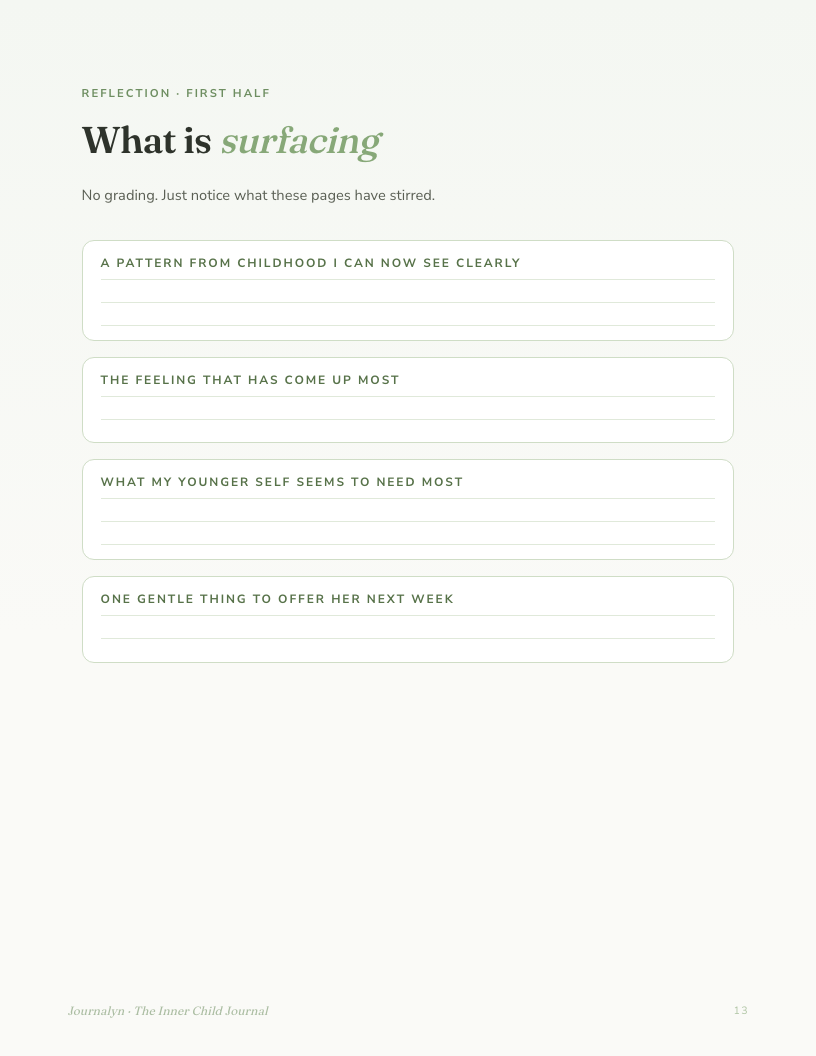
These prompts work in any journal. They are also the foundation of the Journalyn Inner Child Healing Journal.
- What feeling was not allowed in my childhood home? What did I do with it instead?
- When did I first learn that my needs were too much for someone?
- What would I tell an 8-year-old version of me right now?
- Which adult in my life made me feel the most safe? What did they do that created that feeling?
- What emotion do I still struggle to express in front of other people?
- Where did I learn that I had to earn love through performance?
- What does my inner critic sound like? Whose voice does it remind me of?
- If my younger self could speak to me right now, what would she say she needed?
- What is one thing I can do today to be the kind of parent to myself that I needed?
- What belief about myself formed in childhood am I still carrying as if it were fact?
Frequently asked questions
What is the inner child?
The inner child is a psychological concept referring to the part of the adult self that carries the emotional memories, needs, and wounds from childhood. It is not a literal child inside you, but a way of naming the imprint that early experiences leave on adult behavior and emotional responses.
How do you know if you need inner child healing?
Common signs include: disproportionate emotional reactions to certain triggers, a persistent fear of abandonment or rejection, difficulty trusting others, chronic people-pleasing, feeling like a fraud despite external success, and a harsh inner critic voice. These are often rooted in childhood experiences where emotional needs were not consistently met.
Can I do inner child healing without a therapist?
Yes, with caveats. Journaling, self-compassion practices, and structured reparenting exercises are all accessible without a therapist and have real value. However, if you have a significant trauma history, dissociation, or find that the work destabilizes you, please work with a licensed trauma-informed therapist. Self-help tools work best as a complement to, or a step toward, professional support.
What does reparenting mean?
Reparenting means consciously giving yourself the emotional responses you needed as a child but did not receive: validation, safety, permission to feel, boundaries, encouragement, and unconditional presence. It is the practice of becoming the parent your younger self needed.
Is inner child work the same as shadow work?
They overlap significantly. Shadow work (Carl Jung's concept) is the broader practice of bringing the unconscious into awareness, including suppressed emotions, disowned traits, and hidden beliefs. Inner child work is one specific layer of shadow work, focused on the childhood origin of those suppressed patterns. Many people do both simultaneously.
What is a printable inner child healing journal?
A printable inner child healing journal is a structured PDF you download and print at home. It contains guided reparenting prompts, emotional safety exercises, and self-compassion practices designed for the inner child layer of healing work, without requiring you to stare at a blank page.
Written by the Journalyn team. We design printable journals for women, drawing on attachment theory and trauma-informed self-compassion research. This article is for educational purposes. It is not a substitute for professional mental health support.
Ready to start?
Printable Inner Child Healing Journal
28 guided reparenting prompts, an emotional safety mapping exercise, a 7-day self-compassion tracker, and a letter-to-younger-self template. $14.99, instant PDF download.
View the journal →Or see the Inner Child Healing Toolkit (4 PDFs, $27.99) for the full system.