Depression Journal for Women:
5 Prompts to Start Today
By Journalyn · · 7 min read
TL;DR
- Structured depression journaling outperforms blank-page journaling because it counters rumination with direction.
- The most effective prompts combine mood tracking, small wins, and behavioral activation (one tiny action per day).
- Self-compassion prompts are more effective than self-criticism when used in depression journaling.
- A 5-minute structured page beats a 30-minute venting session for depression management.
A depression journal is a structured daily practice that tracks mood, activates small behaviors, and builds a self-compassionate record of your experience, rather than an unstructured place to vent.
Why structure matters in depression journaling
Unstructured journaling carries a risk for depression: rumination. Research by Susan Nolen-Hoeksema and colleagues has consistently shown that repetitively focusing on distressing thoughts without resolution can worsen depressive symptoms. A blank page and the instruction to "write about how you feel" can easily become fuel for the thought loops depression already creates.
Structured journaling works differently. It gives your thinking somewhere to go. A mood rating, a small wins log, a behavioral activation entry, a self-compassion prompt: each section interrupts the rumination cycle and redirects toward observation, action, and self-kindness.
What behavioral activation journaling is
Behavioral activation (BA) is one of the most well-researched CBT techniques for depression. The mechanism is straightforward: depression reduces activity (withdrawal, avoidance, reduced engagement), which deepens depression by removing the positive reinforcement that activity provides. BA interrupts this loop by scheduling and tracking small, achievable actions.
In journal form, this looks like one section per day: "one tiny action toward engagement today." The action does not need to be significant. A 10-minute walk. One text to a friend. Making a meal instead of skipping it. The point is breaking the withdrawal pattern, not performing wellness.
A 2008 meta-analysis in the Clinical Psychology Review found behavioral activation as effective as full CBT and antidepressant medication for moderate-to-severe depression in multiple trials. The self-directed, journaling-based version is less intensive, but the same principle applies.
5 depression journal prompts to start tonight
These prompts form the core of the Journalyn Depression Journal. Use them in any order, in any journal.
1. Mood and energy check-in (1 to 5)
Rate your mood and energy on a 1 to 5 scale, then note one thing that influenced the rating today. The rating itself is almost secondary: the practice of observing your state without judgment is the skill you are building. Over weeks, patterns emerge that are impossible to see day-to-day.
2. Three small wins
Depression is a negativity amplifier. The brain under depression filters for evidence of failure and discounts evidence of competence. Three small wins per day is a deliberate counter-bias practice. They do not need to be significant. "Got out of bed." "Drank water." "Replied to one email." Writing them down makes them real in a way that thinking them does not.
3. One tiny behavioral activation action
Choose one action toward engagement for today. Write it before you do it (intention) and check it off when done (completion). It can be tiny. The point is the loop: intention, action, record. This is the BA principle applied at its most accessible scale.
4. Self-compassion prompt
Write your answer to: "What would I say to a close friend who was having the exact day I just had?" Then say that to yourself instead. This is the core of Kristin Neff's self-compassion framework and it is the single prompt that most directly counters the harsh inner critic that depression amplifies. Research by Neff and colleagues has shown self-compassion to be inversely correlated with depression across multiple studies.
5. Weekly pattern review
Once a week: look back at your seven days. What patterns do you notice in the mood ratings? What seemed to help, even slightly? What made things harder? One observation per category is enough. You are not solving depression in a weekly review; you are building a personal evidence base for what your specific experience responds to.
Structured journal vs blank journaling vs app: what works best?
| Factor | Structured printable journal | Blank journal | App |
|---|---|---|---|
| Rumination risk | Low (structure redirects) | Higher without guidance | Varies by app |
| Screen time | None | None | Yes (phone) |
| Privacy | Complete | Complete | Data on servers |
| Behavioral activation | Built in | Only if you design it | Varies by app |
| Cost | One-time $14.99 | Cost of notebook | Monthly subscription |
Frequently asked questions
Does journaling actually help with depression?
Research suggests structured journaling can support depression management, particularly journaling that incorporates behavioral activation elements (tracking activity and mood) and self-compassion practices. A 2005 meta-analysis by Smyth and Pennebaker found expressive writing reduced depressive symptoms in a number of studies. It is not a replacement for therapy or medication, but it is a well-supported complementary tool.
What should I write in a depression journal?
The most effective depression journals track mood and energy daily, record small wins (to counteract the negativity bias), log one tiny behavioral activation action per day, include a self-compassion prompt, and do a brief weekly pattern review. Avoid pure venting without reflection, as research suggests rumination can worsen depressive symptoms.
What is behavioral activation journaling?
Behavioral activation (BA) is one of the most research-supported CBT techniques for depression. Depression reduces activity, which deepens depression. BA journaling tracks one small action toward engagement each day to interrupt this loop. Even a 10-minute walk, a single phone call, or making a meal counts.
Can I use a depression journal instead of therapy?
No. A depression journal is a self-care tool that works best alongside professional support, not instead of it. For clinical depression, moderate-to-severe symptoms, or thoughts of self-harm, please work with a licensed mental health professional. Journaling can be a valuable between-session practice your therapist may actually recommend.
What if I cannot write on hard days?
On hard days, even a single number (your mood rating) and one small win is enough. The journal is designed so partial use is still useful. A 2-minute version is better than skipping entirely, and skipping is not a failure.
What is a printable depression journal?
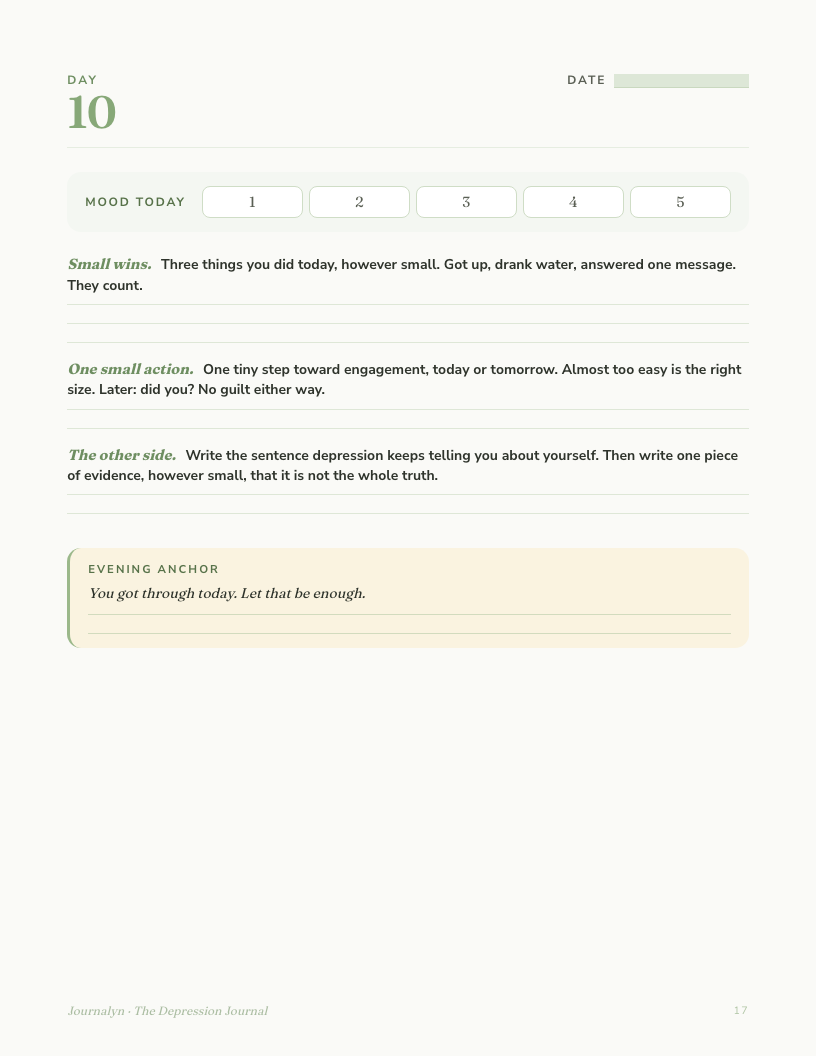
A printable depression journal is a PDF you download and print at home. It contains structured daily pages (mood check-in, small wins, behavioral activation log, self-compassion prompts) without requiring you to stare at a blank page. You print as many copies as you need.
Written by the Journalyn team. We design printable journals for women, drawing on behavioral activation and self-compassion research. This article is for educational purposes. It is not a substitute for professional mental health support. If you are in crisis, please contact a licensed mental health professional or your local crisis line.
Ready to start?
Printable Depression Journal for Women
34 pages of structured daily journaling: mood check-in, small wins, behavioral activation log, self-compassion prompts, and weekly pattern review. $14.99, instant PDF download.
View the journal →Or see the Depression Toolkit (4 PDFs, $27.99) for the full system including a behavioral activation workbook and sleep-mood journal.