How to Set Boundaries:
A Step-by-Step Guide for Women
By Journalyn · · 8 min read
TL;DR
- A boundary is not a demand on someone else. It is a statement about what you will do.
- Five steps: identify the limit, name the need behind it, state it clearly, give a consequence, and follow through.
- Guilt after setting a boundary is normal and does not mean you were wrong.
- Scripts below for the 8 most common boundary conversations.
Setting a boundary means identifying a limit you need, stating it directly and kindly, giving a consequence, and following through when it is tested.
Step 1: Identify where the limit is needed
Resentment is the most reliable indicator of a missing boundary. Where do you find yourself saying yes when you mean no? Where do you feel consistently drained, used, or unseen? Where do you replay conversations and wish you had said something different?
Useful audit areas: your time, your energy, your emotional availability, physical space and privacy, digital availability (phone and messages), how people speak to you, and financial boundaries.
Step 2: Name the need underneath the limit
Every limit protects a need. The need might be for rest, for respect, for safety, for autonomy, for consistency, for emotional reciprocity. When you know the need, the boundary makes sense internally, and it is easier to hold.
Ask: what am I protecting by setting this limit? What happens to me when this limit is crossed?
Step 3: State the boundary clearly
A boundary is not a hint. It is a clear, direct statement. Use first-person language about your behavior, not second-person language about theirs.
Instead of:
"You need to stop calling me so late."
Try:
"I'm not available for calls after 9pm. If you call after that time I won't be answering."
Step 4: State a consequence
A limit without a consequence is a request. It may or may not be honored. A consequence makes the boundary real. The consequence must be something you are willing and able to actually follow through on.
Common consequences: leaving the room or conversation, not answering a call or message, reducing time spent with someone, ending a conversation, or explicitly naming that you will address the pattern differently going forward.
Step 5: Follow through
This is where most boundary-setting fails. The limit is stated, tested, and the consequence is not enforced. People test limits to see if they are real. When you do not follow through, you teach the other person that the boundary is negotiable.
Following through will feel uncomfortable. You may feel guilty, unkind, or like you are causing a problem. That discomfort is the price of a real limit. It decreases over time.
8 boundary scripts for common situations
With a parent who criticizes your choices
“When you comment on [X], I feel undermined. I need us to talk about other things when we are together. If it continues, I will end the call.”
With a partner who dismisses your emotions
“When you say [X], I feel unheard. I need you to listen without fixing or minimizing. Can we try that?”
With a friend who consistently cancels
“I value our friendship and I've noticed a pattern of last-minute cancellations. I'm not able to keep rearranging my plans for it. I'd love to make plans when you're sure you can make them.”
With a colleague who oversteps
“I'm happy to [X], and [Y] is outside what I can take on right now. I want to be clear about my capacity so we can plan realistically.”
With a request you cannot meet
“I'm not able to do that. I hope you find what you need.”
With someone who pushes after you've said no
“I've already answered. My answer is no.”
With a family member who crosses physical boundaries
“I don't want to be hugged right now. Please ask before physical contact.”
With digital availability expectations
“I'm not available to respond to messages in the evenings. I'll get back to you the next day.”
Boundaries in practice vs. boundaries in theory
| What people expect | What actually happens |
|---|---|
| Setting a boundary resolves the problem | It communicates your limit; the other person still chooses their response |
| Everyone will respect it | Some people will test it, push back, or react with hurt or anger |
| You will feel immediately relieved | You will likely feel guilty first, then relieved after following through |
| One conversation is enough | Most limits need to be restated and followed through on multiple times |
Frequently asked questions
Why is it hard to set boundaries?
Boundary-setting is difficult for most people because it requires tolerating discomfort: the discomfort of potentially disappointing someone, the guilt of prioritizing yourself, and the fear that setting a limit will damage or end a relationship. For women in particular, many were socialized to be accommodating, agreeable, and other-focused. Setting a boundary can feel like being selfish, even when it is simply self-respecting.
What is a boundary?
A boundary is a limit you set about what you are willing to accept or do. It is not a demand placed on another person (you cannot control someone else's behavior). It is a statement about what you will do or not do: "If X continues, I will Y." A boundary without a consequence is a wish.
How do you set a boundary without being aggressive?
Use a calm, direct statement rather than an accusation. Lead with your experience, not your judgment of the other person. State the limit clearly and explain the consequence. "When X happens, I feel Y, and I need Z" is a useful structure. Assertive does not mean aggressive: it means clear, honest, and kind.
What do you do when someone does not respect your boundary?
Follow through on the stated consequence. This is where most boundary-setting fails: the limit is stated but the consequence is not enforced. If you said "If you continue to call me after 9pm I will not answer," do not answer. Following through is what communicates that the boundary is real. People will test limits to see if they hold.
Is it normal to feel guilty after setting a boundary?
Yes, and it does not mean you did something wrong. Guilt after a boundary often comes from the mismatch between the self-abandoning behavior you learned as a child and the new, self-respecting behavior you are building. The guilt tends to decrease with practice and with the experience of relationships surviving the limit.
What is a printable boundaries workbook?
A printable boundaries workbook is a structured PDF you download and print. It typically contains a boundary audit across different life domains, reflection exercises for identifying where limits are needed, script templates for common boundary conversations, and a practice structure for building the habit of holding limits over time.
Written by the Journalyn team. We design printable journals for women, drawing on values-based communication and attachment-informed self-care. This article is for educational purposes. For significant relationship safety concerns, please seek qualified support.
The full system
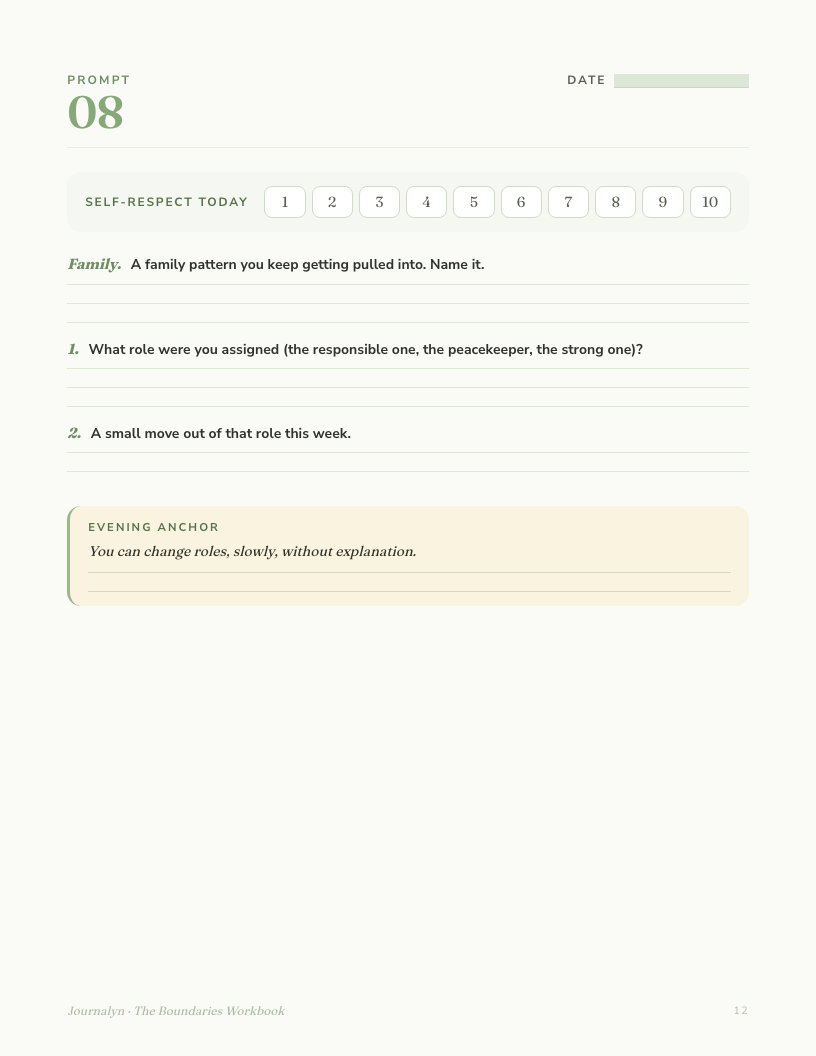
Printable Boundaries Workbook
23 pages: 4-domain boundary map, 12 script archetypes, over-functioning audit, and a 30-day boundary log. Plus the full Boundaries Toolkit with 50+ scripts, a people-pleasing journal, and a post-no recovery guide. $14.99 single, $27.99 toolkit.
View the workbook →Or see the Boundaries Toolkit (4 PDFs, $27.99) or the Boundaries Collection (10 PDFs, $49.99).