Mindfulness for Beginners:
A No-App Guide for Women
By Journalyn · · 7 min read
TL;DR
- Mindfulness is deliberately noticing what is happening now, without automatically reacting.
- You do not need an app or a meditation cushion to practice it.
- Three entry points: mindful breathing, body scanning, and written noticing.
- 10 journal prompts below for starting a written mindfulness practice tonight.
Mindfulness means deliberately paying attention to the present moment without judgment. You can practice it in 5 minutes a day, on paper, without any app.
What mindfulness actually is (and is not)
Mindfulness is not clearing your mind. The mind will produce thoughts. Mindfulness is noticing that you have had a thought and choosing to return your attention to the present moment without getting swept along in it.
Mindfulness is also not relaxation, although relaxation can be a side effect. It is not spiritual practice, although it can be. It is a training in attention and present-moment awareness that has been extracted from its Buddhist origins and studied extensively as a secular psychological practice.
3 ways to start without an app
1. Mindful breathing (3 to 5 minutes)
Sit comfortably. Set a timer for 3 to 5 minutes. Breathe naturally. Notice the physical sensation of each breath: the air entering your nose, your chest or belly rising, the air leaving. When your mind wanders, notice that it has wandered, and gently return to the breath. That noticing and returning is the practice.
2. Body scan (5 to 10 minutes)
Lie down or sit. Bring your attention to the top of your head. Slowly move your attention down through the body: forehead, jaw, throat, shoulders, chest, stomach, hands, hips, legs, feet. At each region, simply notice what is there: tension, warmth, tingling, nothing. Do not try to change anything. The goal is noticing, not fixing.
3. Written mindfulness (5 minutes)
Bring attention to the present moment and write what you notice: sensations, sounds, the quality of light, the feeling in your body right now. This is not journaling about your thoughts and feelings. It is writing what is directly observable, as if you are a scientist noting data. It trains the same attention muscle as seated meditation.
A simple 5-minute daily practice
- Pause (30 seconds). Put down what you are doing. Sit with no task.
- Three conscious breaths (1 minute). Notice the sensation of each one fully.
- Body check-in (1 minute). Where do you feel tension? Where do you feel ease?
- Written noticing (3 minutes). Write 5 things you can directly observe right now through your senses.
10 written mindfulness prompts
Use any of these as a 5-minute practice. They form the foundation of the Journalyn Mindfulness Journal.
- What are 5 things I can notice right now through my senses?
- Where in my body am I holding tension right now? What does it feel like?
- What is the quality of my mind right now: scattered, focused, tired, alert?
- What thought has been most persistent today? Can I observe it without identifying with it?
- What am I feeling emotionally right now, and where does that show up in my body?
- What am I resisting right now? Can I simply notice the resistance without fighting it?
- What did I taste at my last meal? How much of it did I actually notice?
- What sound can I hear right now that I had stopped noticing?
- What happened today that I was only half-present for? What would full presence have looked like?
- What is one thing I can do in the next 10 minutes with my full attention?
Printed journal vs. mindfulness app
| Factor | Printed journal | App (Calm, Headspace) |
|---|---|---|
| Requires a screen | No | Yes |
| Cost | $14.99 once | $70 to $100/year subscription |
| Notification risk | None | Built into the same device |
| Physical record | Yes, returnable | No |
| Depth of noticing | Writing engages more processing | Audio guides do the work for you |
Frequently asked questions
What is mindfulness?
Mindfulness is the practice of deliberately bringing attention to the present moment, without judgment. It is not about stopping thoughts, feeling calm, or achieving a particular state. It is about noticing what is actually happening right now, including discomfort, without automatically reacting to it.
Do I need to meditate to practice mindfulness?
No. Formal meditation (sitting quietly for 10 to 20 minutes) is one way to practice mindfulness, but informal mindfulness is equally valid: eating without your phone, noticing sensations while walking, taking a breath before responding to a message. Many people develop a robust mindfulness practice without ever doing a formal sitting meditation.
How long does it take to see benefits from mindfulness?
Research on MBSR (Mindfulness-Based Stress Reduction) shows measurable changes in stress reactivity and emotional regulation after 8 weeks of consistent practice, with some studies showing changes after as few as 4 weeks. Informal daily practice produces benefits; the key variable is consistency rather than duration.
Is mindfulness evidence-based?
Yes. Mindfulness-Based Stress Reduction (MBSR) and Mindfulness-Based Cognitive Therapy (MBCT) are among the most studied psychological interventions. They are recommended by the NHS in the UK for recurrent depression and have strong evidence for reducing stress, anxiety, and emotional reactivity. The evidence for informal mindfulness practice is less studied but directionally positive.
Why use a printed journal instead of a mindfulness app?
Mindfulness apps require picking up a screen, which tends to trigger the notification-checking, multitasking behavior that mindfulness is designed to counter. A printed journal is offline, screen-free, and gives you a physical record to return to. There is also evidence that handwriting engages deeper processing than tapping.
What is a printable mindfulness journal?
A printable mindfulness journal is a structured PDF you download and print at home. It contains written prompts for cultivating present-moment awareness, a daily log for informal practice, and structured exercises for building body awareness and emotional noticing. It is a paper-based alternative to mindfulness apps.
Written by the Journalyn team. We design printable journals for women, drawing on MBSR and mindfulness research. This article is for educational purposes. For anxiety, depression, or PTSD, please speak with a licensed therapist about whether a mindfulness-based intervention is appropriate for you.
Start on paper
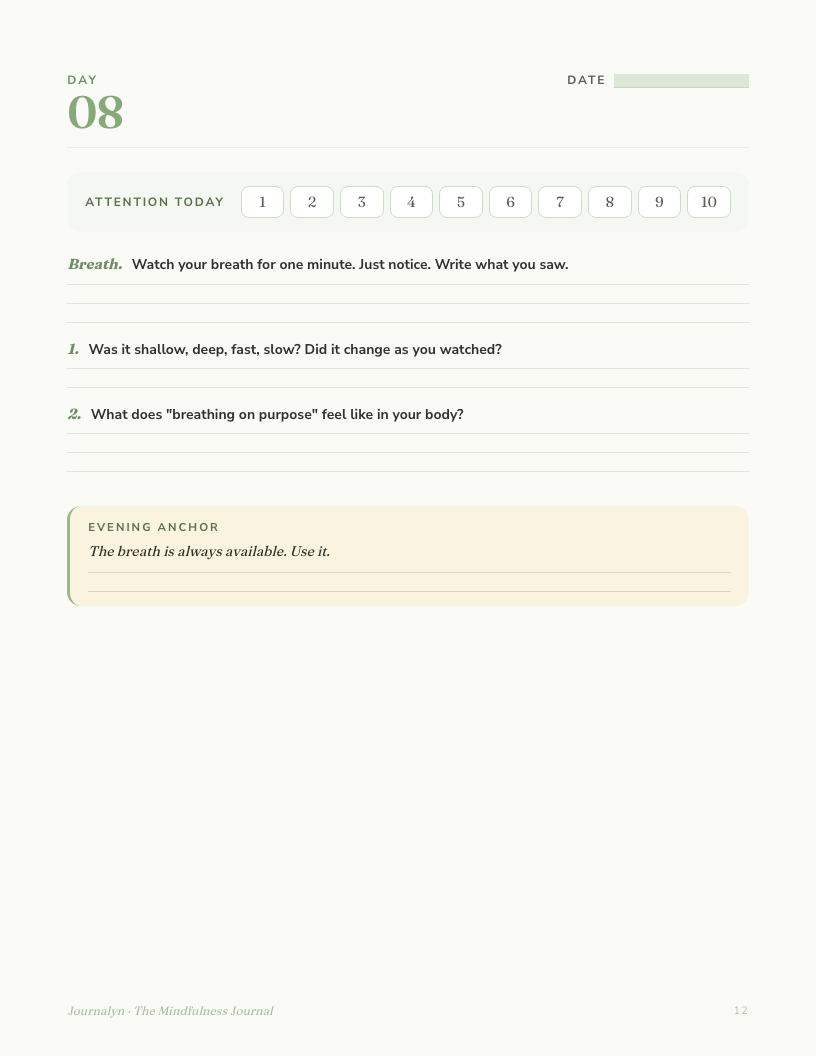
Printable Mindfulness Journal
23 pages: 30 secular MBSR-style prompts, a daily 5-minute log, body-scan check-ins, breathing reference, and a weekly and monthly reflection. No streaks, no app, no screen. $14.99, instant PDF download.
View the journal →Or see the Mindfulness Toolkit (4 PDFs, $27.99) for the full system.