Sleep Journal for Women:
5 Sections for Better Sleep
By Journalyn · · 7 min read
TL;DR
- A sleep journal surfaces the behavioral patterns that disrupt sleep: invisible without data, obvious after 2 weeks of tracking.
- The 5 most useful sections: nightly diary, sleep hygiene tracker, pre-sleep wind-down log, night anxiety pages, and weekly pattern review.
- Paper beats phone at bedtime: blue light suppresses melatonin and opening a phone opens a portal to everything that raises arousal.
- CBT-I, the clinical first-line for insomnia, starts with exactly this kind of diary. You can do the self-led version at home.
A sleep journal does not improve sleep directly: it makes poor sleep legible, which is the prerequisite for fixing it.
Why sleep problems need a paper trail
Most women experiencing poor sleep think they already know what is causing it. They are usually partially right and partially wrong. They know the obvious surface causes (stress, the new baby, the 2am phone check) but miss the behavioral patterns that have become invisible through repetition: the coffee after 2pm that correlates with 3am waking, the evening Netflix that pushes bedtime past the sleep window, the weekend sleep-in that shifts the circadian rhythm and ruins Sunday night.
A sleep diary makes these correlations visible. Cognitive Behavioral Therapy for Insomnia (CBT-I), the first-line clinical treatment recommended by the American College of Physicians ahead of sleep medication, begins with a 2-week sleep diary baseline for exactly this reason. You cannot change patterns you cannot see.
The 5 sections of a useful sleep journal
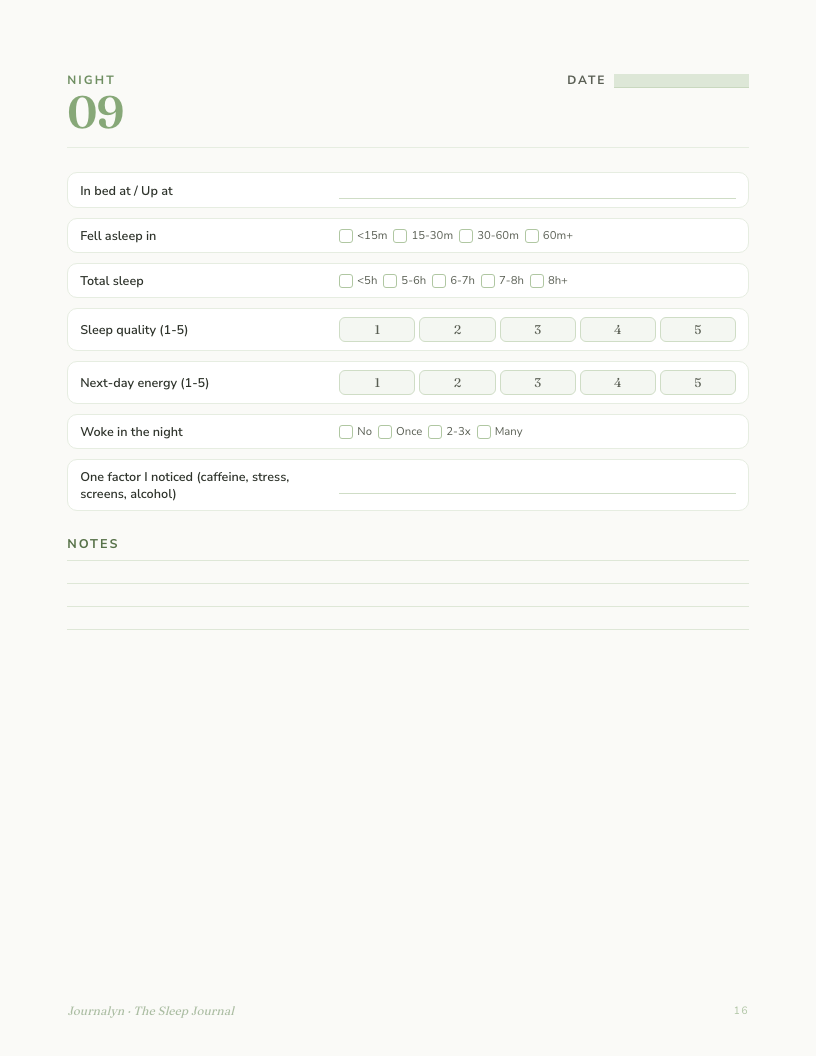
1. Nightly sleep diary
Track 7 data points each morning (takes 2 minutes):
- Bedtime (when you got into bed)
- Lights out time (when you stopped screens and tried to sleep)
- Time to fall asleep (estimate)
- Number of night wakings and total time awake
- Wake time
- Sleep quality (1–5)
- Morning energy (1–5)
After 2 weeks, calculate your average sleep efficiency: (time asleep / time in bed) × 100. Below 85% is clinically considered poor sleep efficiency and is the primary target of CBT-I sleep restriction.
2. Sleep hygiene habit tracker
A 30-day tick log for the 8 behavioral factors with the strongest evidence for sleep quality: screen cutoff time (90 minutes before bed), caffeine cutoff (before 2pm), consistent wake time (including weekends, this is the single most powerful circadian anchor), alcohol (disrupts sleep architecture even when it helps you fall asleep), exercise timing (morning or afternoon, not within 3 hours of bed), evening light exposure, bedroom temperature, and pre-sleep wind-down ritual.
The tracker reveals which habits are actually consistent versus which ones you think are consistent. Most people discover 2 to 3 habits they believed they had but did not.
3. Pre-sleep wind-down log
A 3-step evening anchor, done 20 to 30 minutes before bed: a brain dump (everything on your mind, out of your head and onto paper), tomorrow's top 3 (so your brain stops rehearsing the to-do list in the night), and one thing that was good today. The research on pre-sleep worry journaling by Borkovec and colleagues found that scheduling worry time earlier in the evening reduces nighttime intrusive thoughts.
4. Night anxiety pages
For the racing mind that arrives at bedtime: a structured worry containment exercise. Write the thought down, write when you will think about it (tomorrow morning, not now), and close the page. The act of writing creates a sense of completion that reduces the cognitive arousal maintaining the loop. This is the cognitive component of CBT-I's stimulus control technique.
5. Weekly pattern review
Ten minutes at the end of each week: what was the average sleep quality, what correlated with better nights, what correlated with worse nights, one habit to focus on next week. Over 4 to 6 weeks, this review turns a pile of data into a personal sleep protocol, the habits that demonstrably help your specific sleep, not the generic advice.
Paper vs phone for sleep tracking
| Factor | Paper sleep journal | Sleep tracking app |
|---|---|---|
| Blue light at bedtime | None | Yes (suppresses melatonin) |
| Distraction risk | Zero | Opens portal to notifications |
| Night anxiety support | Dedicated containment pages | None |
| CBT-I integration | Built in | Rarely included |
| Cost | One-time $14.99 | Monthly subscription |
Frequently asked questions
Does keeping a sleep journal actually improve sleep?
A sleep journal alone does not directly improve sleep, but it enables the interventions that do. The nightly diary surfaces patterns (the coffee at 3pm correlating with 2am waking, the evening screen time correlating with time-to-fall-asleep) that are invisible without data. CBT-I, the first-line clinical treatment for insomnia, begins with a 2-week sleep diary baseline because pattern visibility is the prerequisite for targeted behavioral change.
What is the most important thing to track in a sleep journal?
The most clinically useful single data point is time in bed vs time actually asleep (sleep efficiency). From there: time to fall asleep, number of night wakings, and morning mood and energy rating. The patterns in these five numbers across 2 to 3 weeks tell you more about your sleep than any wearable device.
Should I use a sleep journal app or a paper journal?
Paper is consistently better for pre-sleep use. Checking a phone at bedtime exposes you to blue light (which suppresses melatonin) and to notifications, social media, and email, all of which increase arousal at the worst possible time. A paper journal requires no phone and produces no blue light. The trade-off is that apps can generate charts automatically; a paper journal requires you to do the weekly review manually, which takes about 10 minutes.
What is stimulus control in sleep journaling?
Stimulus control is a CBT-I technique that retrains the brain to associate the bed with sleep rather than wakefulness. The core rules: only go to bed when sleepy (not just tired), get out of bed if you cannot sleep after 20 minutes, use the bed only for sleep and sex. A sleep journal supports stimulus control by tracking whether you followed the rules and noting the correlation with sleep quality.
How long do I need to track before seeing results?
Two to three weeks of consistent nightly logging typically surfaces the most significant behavioral patterns. Sleep itself may not improve immediately, the CBT-I process can temporarily worsen sleep in the short term before improving it. Behavioral sleep interventions generally show measurable improvement within 4 to 6 weeks.
What is a printable sleep journal?
A printable sleep journal is a PDF you download and print at home. It contains structured nightly tracking pages (sleep diary), a sleep hygiene habit tracker, pre-sleep wind-down pages, night anxiety exercises, and a weekly pattern review. It is paper-based, requires no phone at bedtime, and is fully private.
Written by the Journalyn team. We design printable journals for women. This article draws on CBT-I research and sleep hygiene evidence. For clinical insomnia or sleep disorders, please see a licensed healthcare provider.
Ready to start tracking?
Printable Sleep Journal for Women
32 pages with all 5 sections: nightly sleep diary, sleep hygiene 30-day tracker, pre-sleep wind-down log, night anxiety containment pages, CBT-I quick reference, and weekly pattern review. $14.99, instant PDF download.
View the journal →Or see the Sleep Toolkit (4 PDFs, $27.99) which adds a full CBT-I workbook, pre-sleep anxiety release pages, and a sleep hygiene overhaul guide.